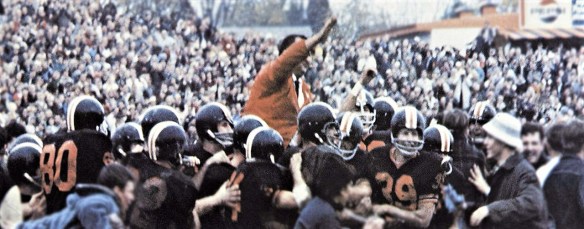
The Great Pumpkin and the 1967 Beavs
Nothing captivates a state or geographical entity more than a team labeled as an “underdog” which whether by adrenalin, good coaching, mental toughness of team members or a combination thereof, not only exceeds expectations, but also establishes a legacy – a story that will inspire future generations. The team is usually remembered not only for its achievements, but the character and stories of its individual members and coaches.
In Oregon, I can think of a few that fit this category.
The 1937 Bellfountain High School Basketball Team – this unincorporated Benton County berg with a high school attended by twenty-seven students had a basketball team of eight boys, none over 6 feet tall. Burton “Bill” Lemmon coached the Bells to a 17 and 1 season which included two wins over the Willamette University freshman team!

Bellfountain High School in 2009
In a fascinating Portland Tribune story about the season, George Edmonston Jr. (also the retired editor of the OSU Alumni Magazine) tells the story of how “The Giant Killers” won the State Championship when all schools regardless of size played in the same tournament.
In the semi-finals Lincoln defeated McLoughlin and Bellfountain cruised to a 39-13 victory over Portland’s Franklin (still known as “The Quakers” – at least then…..) The Bells then beat Lincoln 35 to 21.
“To realize the size differential between the two contenders, consider that Lincoln High in 1937 had almost twice as many teachers as Bellfountain had students. Lincoln’s student body numbered 1,580, who attended classes in a building that had 45 rooms and occupied an entire city block.” http://pamplinmedia.com/nbg/144-features/247929-116273-tales-from-the-grubby-end-oregons-version-of-hoosiers
The 1964 Portland State GE College Bowl Team – The Portland State College team, led by its captain, Jim Westwood (Beerchaser of the Quarter in March 2013) and coached by Professor Ben Padrow played the upset role by defeating their opponents for five straight weeks on national television before they retired as champions with the sum of $15,275 in scholarships – a large sum at the time.

Jim Westwood (second from left) and the PSC Team with Padrow (right)
“The 415 points scored in their final match ties them for fifth-highest single-game total achieved, and their 1725 points total set a new record at the time and is fourth highest overall.
The March 26, 1965 issue of Time has an article on how the College Bowl victories helped change Portland State’s image as “the flunk-out school” for University of Oregon and Oregon State drop-outs…” (“Portland State Alumni Association News” article by Kathryn Kirkland, May 2, 2005)
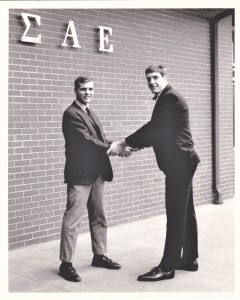
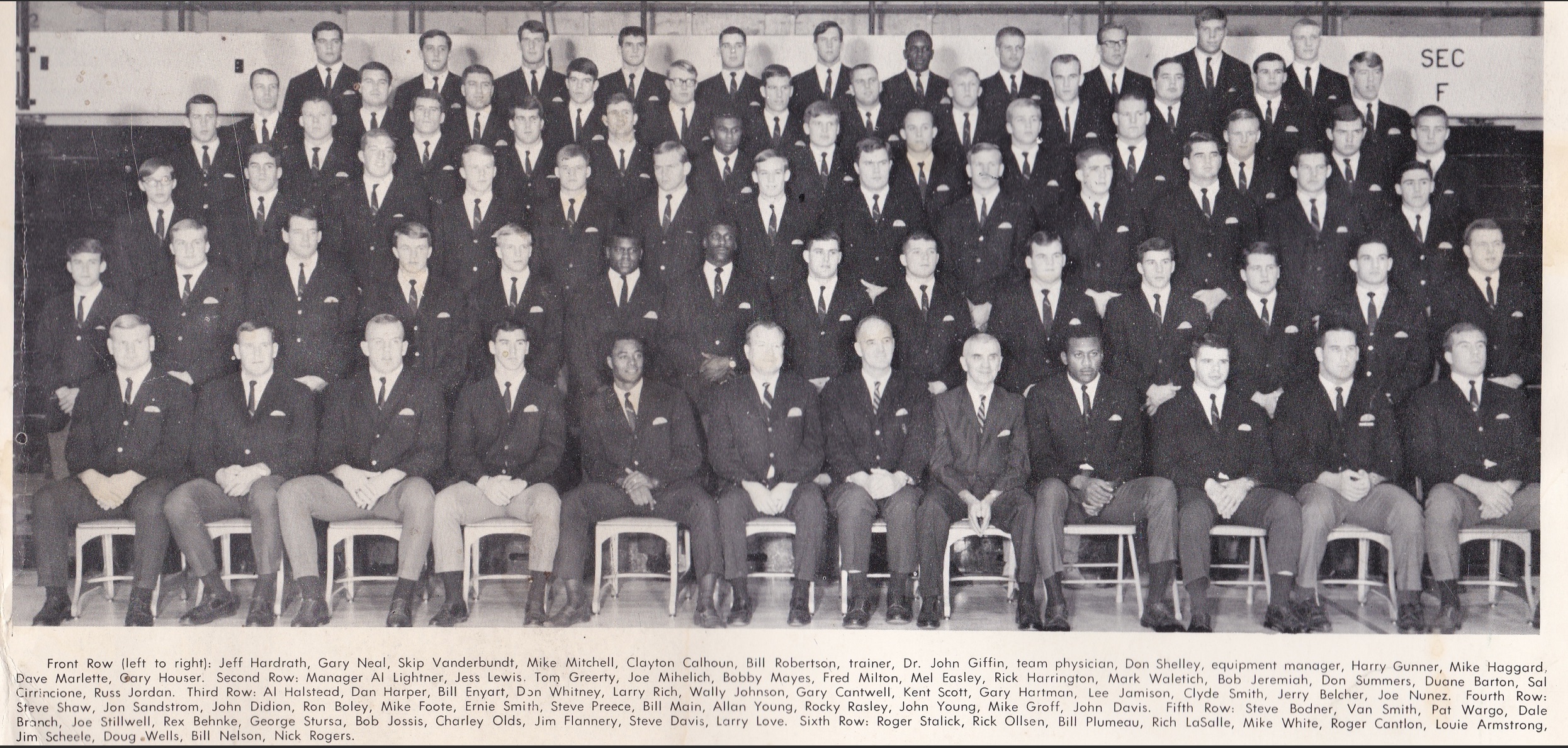
The 1967 Oregon State Football Team aka “The Giant Killers” – This post will be followed by two additional Beerchaser narratives on the story of the greatest magnitude in the State’s athletic history. It’s personal to me because I was at OSU as a sophomore in 1967, attended the games and lived with ten members of that fabled team in the Sigma Alpha Epsilon fraternity.
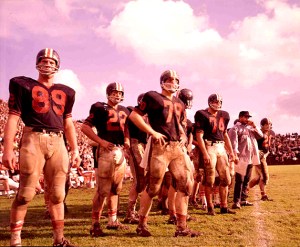
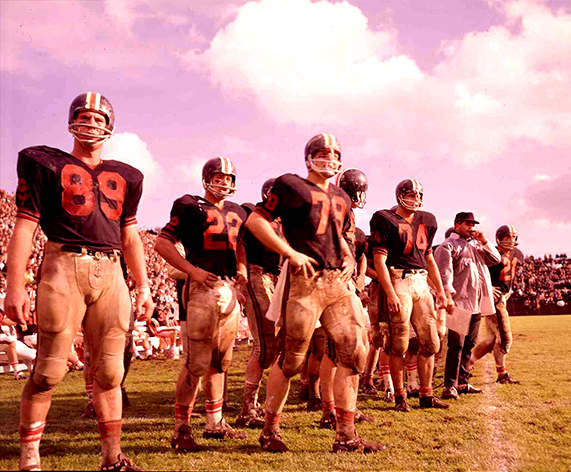
Gary Houser #89…Billy Main #22…Nick Rogers #79…Roger Stalick #74…Donnie Summers #21…and Coach Sam Boghosian.
You will see why this story deserves commemoration, but to put the season into perspective before getting into the details:
“In a four-week period, the Beavers became the only team to ever go undefeated against three top two teams in one season since the inception of the AP Poll, earning the nickname ‘Giant Killers.’ https://en.wikipedia.org/wiki/1967_Oregon_State_Beavers_football_team
The Giant Killer Legend
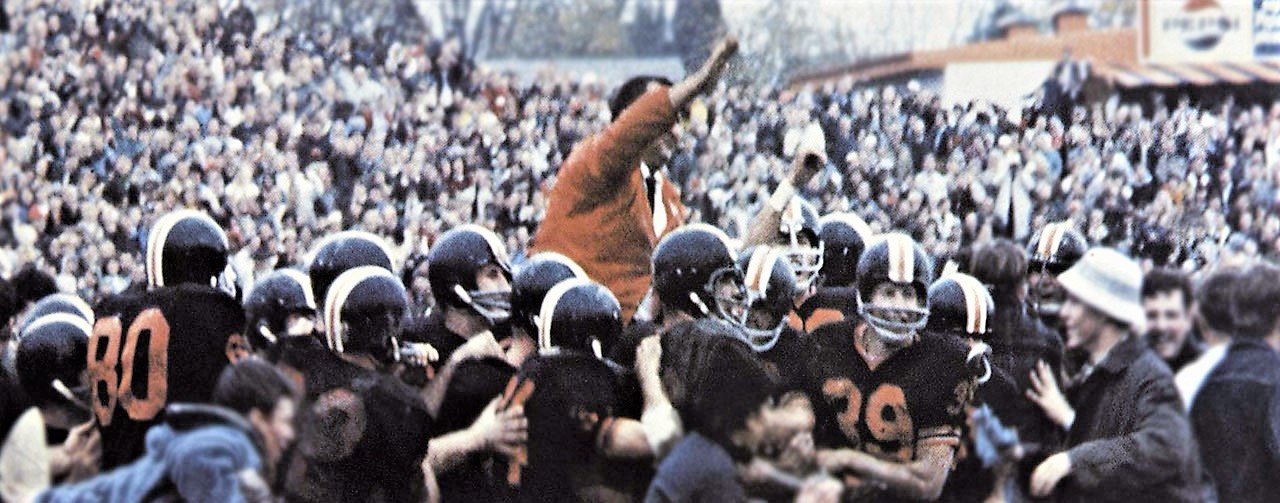
The Beaver team, led by the late coach, Dee Andros – also known as “The Great Pumpkin” – compiled a record of 7-2-1 that year. As a sophomore standing in the student section, I can still remember the electricity in the air and history in the making as the fourth quarter ticked down when OSU was ahead of No.1 ranked USC 3 to 0 on a November Saturday afternoon.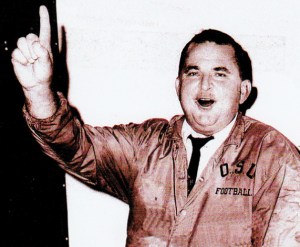
But one has to remember that this victory was only the apex of a tale that not only captivated the State of Oregon, but garnered the attention of sportswriters and coaches throughout the nation.
The soon to be Giant Killers started their journey in West Lafayette, Indiana where 60,147 fans saw the unranked Beavers topple the No. 2 ranked Purdue Boilermakers 22-14. Keep in mind that this game was after two disappointing back-to-back OSU defeats to the Washington Huskies and BYU (at Parker Stadium in Corvallis).
Purdue had won nine straight games including nine consecutive wins at home. Many of their fans wondered why their Boilermakers were playing this Podunk team from the West Coast. Starting defensive back, Larry Rich, remembers Purdue students ridiculing the Beavs as they walked through campus wearing their team blazers.
As they got to the locker room quite a bit before they had to dress-down, the Beav’s Equipment Manager brought out a bunch of pads for players who might want to lie down and rest before the game. Rich said that the manager was promptly chastised for suggesting that they recline on the same pads that the Notre Dame Irish had used a few weeks before.
After the Purdue triumph, the Beavers had a record of 4 and 2.
One of the great stories from that game involves the late long-time Beaver sportscaster, Bob Blackburn, who broadcast the Beaver games on KEX Radio.

The late Bob Blackburn in his tux
He was also the announcer for the new Seattle Super Sonics basketball team and on October 21, broadcast their maiden game at home with the Houston Rockets. Black-tie was the appropriate dress for the evening.
“His wife Pat, remembered after the game, ‘I rushed him to the airport so he could get to Purdue to do the Oregon State football game, and he didn’t have time to change out of his tuxedo.'” (Feedback Radio.com 1/8/15)
Blackburn, when asked about it stated:
“Upon seeing me in the tux, Andros said that if Oregon State won the game, I would have to wear the tux for the remainder of the season…..As luck would have it, Oregon State, a 14-point underdog, upset Purdue. And, of course, I had to wear the tux for the next seven games.” (The World 10/23/2003)
The first time the Beavers will face Purdue after that 1967 victory will be in 2021 when they play their season opener at West Lafayette. It will be followed in 2024 by a rematch at Reser Stadium. (Oregon Live 12/5/17)
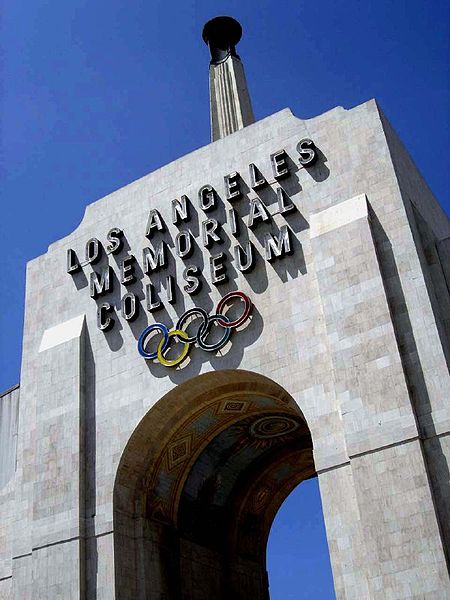
After Purdue, OSU racked up another victory at home over Washington State. Then on November 4th, they traveled to Los Angeles to take on another No. 2 ranked team – UCLA – in Memorial Coliseum with an attendance of 50,172. The Bruins were led by quarterback Gary Beban, who was to become the 1967 Heisman Trophy winner. The OSU strategy was to keep the ball away from the Bruin offense. The end result – a 16 to 16 tie and Beban ended with 21 net yards on 16 carries.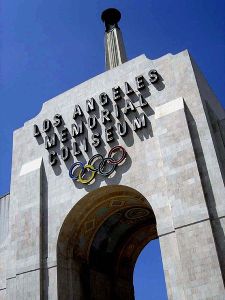
Reporter Jack Rickard wrote in the November 6th Corvallis Gazette Times, “It wound up as a stalemate on the scoreboard. Prothro once said that a tie is like kissing your sister…..That’s not bad if your sister is No. 2.”
The next weekend was filled with anticipation as the Beavs returned to Corvallis in a game attended by Governor Tom McCall and California Governor, Ronald Reagan along with 41,494 fans on Veterans’ Day who witnessed a 19-gun salute at the start of the game.
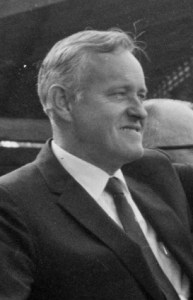
Gov. McCall won a case of oranges that day from Gov. Reagan
The governors, as grand marshals, had both ridden horses in the traditional Veterans’ Day parade in Albany which always draw thousands. They made the 14.5 mile trip to Parker Stadium in Corvallis in a Model T.
“Cars moved at the proverbial snail’s pace, and at one time were backed up for five miles on the freeway north of Albany. It took some Corvallis residents who drove to the game an hour to get home following the game. Some out-of-town visitors didn’t arrive at Parker Stadium until half time.” Corvallis Gazette Times 11/13/67
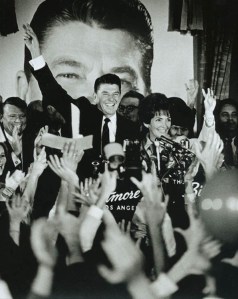
Reagan Celebrating victorious gubernatorial campaign BUT no victory in Corvallis!
When thinking about orange juice, it was usually in the context of what the less restrained OSU kids slurped out of their vodka-infused oranges they “smuggled” into Parker Stadium for consumption during the games.
But that Saturday, “The Juice,” contemplated was O.J. Simpson, who started the game with two spectacular runs. The field was muddy although it did not rain during the game. At halftime, however, the game was a scoreless tie:
“The start of the second quarter marked perhaps the most famous defensive play in the history of Oregon State football. O.J. shook off a tackle at his own 37-yard line, bounced to the outside, and found himself with an expanse of open field and three blockers to lead the way.
Safety Mark Waletich was the only Beaver who seemed to have a chance to bring him down, but with three Trojan blockers to contend with, the odds were not in his favor.
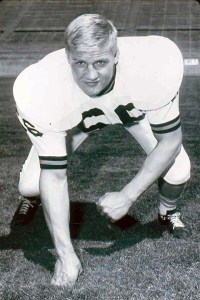
Jess Lewis – legendary tack
Simpson slowed to set up these blockers, not realizing that Beaver defensive tackle Jess Lewis was coming up fast. Never giving up on the play, Lewis quickly closed the gap and made a touchdown saving tackle at the Beaver 32-yard line – over 30 yards downfield from the line of scrimmage.” (BeaversEdge.com 11/11/67)
As Mike Chamess, now a Portland insurance consultant, but then a freshman reporter and later Editor of the OSU newspaper, The Barometer, stated in a recent e-mail:
Mike Chamness – then a freshman reporter
“…my Dad, Art, and my brother, Danny, came down to the USC game when we ‘squeezed the Juice’ for 3 to 0 win. My dad told stories about going to that game for the rest of his life until he passed away in 2012 at the age of 97!”
And was the game exciting? Definitely, to a tragic extent. In fact, Quentin B. Zielinskis, a 48-year old professor of horticulture and according to the Gazette Times, “an ardent sports fan” died of a heart attack at the game. (Yes, Oregon State was an aggie college…..)
At that time, freshmen could not play on the varsity and the rook team was playing Treasure Valley Community College after a long bus ride to Ontario, Oregon. As future All-American and then NFL defensive lineman, Craig Hanneman, stated in an e-mail:
“We were playing that same day at the same time in Ontario and were getting updates when we’d come off the field during possession changes. Someone, I presume, had a transistor radio in the stands and was relaying the 0-0 score and then the 3-0 update down to our bench. It was pretty cool when we heard the final score. Anyway, I was already at OSU, but just couldn’t play varsity. Jess was, of course, a big factor in why I came to Corvallis and pledged SAE.”

Dirt and “The Dude.”
USC went on to win the Rose Bowl against Indiana 14 to 3. O.J. Simpson was the most valuable player.Their only loss was to the Giant Killers. USC ranked first in both the final AP and Coaches poll and outscored opponents 258 to 87.
Any OSU alum, or for that matter, any Oregonian interested in one of the great historic athletic tales of the State of Oregon, should visit the website below developed by Jud Blakely for the complete story. It is a labor of love by this OSU alum and I consider it the War and Peace equivalent to sports websites.
https://www.oregonst67giantkillers.com/
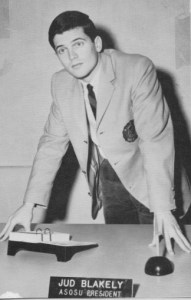 Jud, was Oregon State Student Body President in 1964-1965 and also a member of SAE. After graduation, he served as a Marine Corps Officer for thirteen months as an infantry platoon leader in Viet Nam – being awarded the Bronze Star and earning two Purple Hearts. He has spent years researching, documenting and gathering statistics, video and stories from newspapers and the players themselves on the 1967 OSU team.
As Jud stated in the dedication to the players:
“The Giant Killers of Oregon State. Epic. Recalled so often––and honored so often––for all the right reasons. You were ‘grace under pressure’ again…and again…and again. You were the Laws of Physics in action again…again…again. You epitomized the marvel of a ‘team.’
……..One concern is the slow, steady, historical ‘fading out’ of a unifying sense of respect for a Great Thing. But the fact is…few Great Things have survived the passing of time in their original form……This website is an interactive home for many of those details—videos and audios, game programs, photos, and other resonating pieces of the puzzle of what drove you to become Great and memorable.
And so…I wanted to step off on a mission of discovery in 2002 to begin to gather up your words of recollection and cautious pride…and to craft a faithful story of what you lived 50 years ago, which is as fully alive and exuberant in you now as then.”

Craig Hanneman (right) on Mount Everest Climb
This blog periodically names the Beerchaser-of-the-Quarter and past recipients have included athletes (and mountain climbers including Craig “The Dude” Hanneman), war heroes, authors, academics and media personalities.
They may or may not have anything to do with bars or beers, but have made a contribution to society or have an interesting story which bears telling. Even the crew of the USS Constitution was named in 2012 for their legendary 1798 war cruise.
Jud, himself, has a compelling personal history which I narrated in 2013 when he was named Beerchaser-of-the-Quarter.
Beerchaser of the Quarter – George M. (Jud) Blakely III
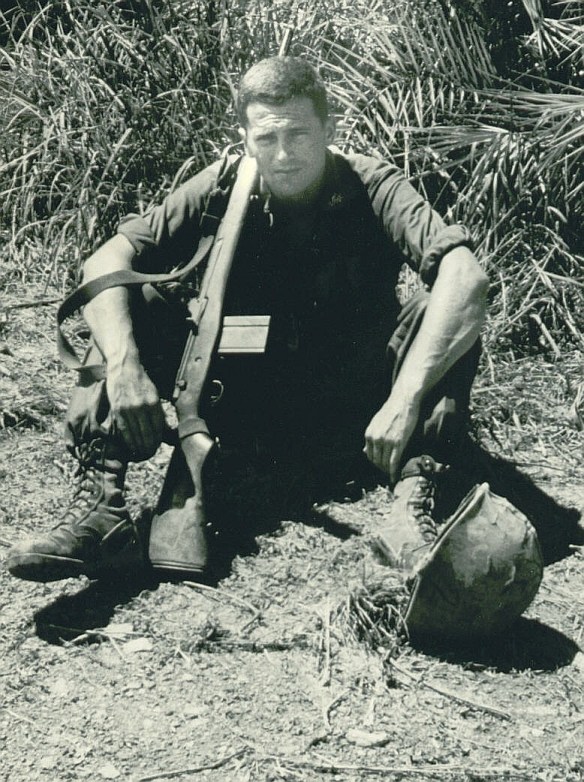
Jud after patrol in 1966 at Than Thrah Viet Nam
1967 on the OSU Campus
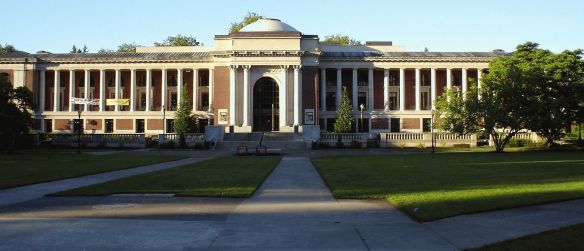
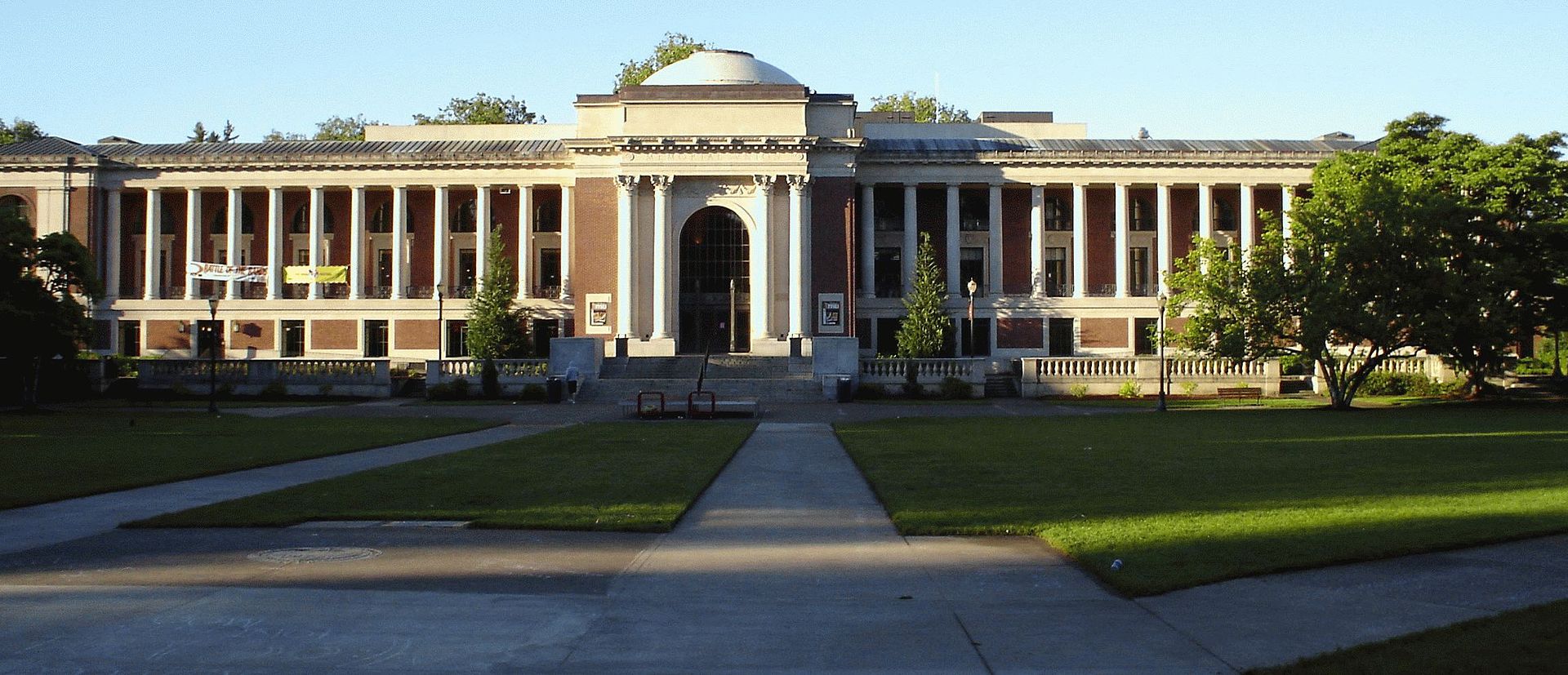
The Memorial Union – a classic structure at the center of campus
These were days when college life was a really enjoyable, albeit protected, environment – largely insulated from the growing conflict in Viet Nam that had begun taking the lives of our former high school classmates. Although we liberal arts majors occasionally wondered how we were going to make a living after college and males would ponder the end of student draft deferments, those four years were a time to grow, meet people and receive what was a solid education.
The term “lottery” was not associated with the video games that the State of Oregon has used since 1984 to supplement its revenue budget, nor the NBA rookie draft lottery commencing in 1985.
The lottery in the minds of most males over eighteen during those years was the military draft lottery which commenced in 1970. If you got a high number, you would essentially escape military service unless you otherwise volunteered. And even if one had a low draft number, college enrollment meant you were deferred from conscription – until you graduated or flunked out.
On that December 1, 1969 night when Roger Mudd of CBS interupted Mayberry RFD to broadcast the drawing from Selective Service headquarters in Washington D.C., many young men around the nation gathered around TV sets hoping they would not “win the lottery!” After the capsules were drawn, September 14th was 001 and my May 4th birthday was No. 276 although for NROTC guys, the issue was somewhat irrelevant.

Trial by (or over) fire for Blakely
Oregon State, not being an urban university and largely an “aggie college” in the peaceful berg of Corvallis, was not on the forefront of current global affairs. This would change to some extent in the years following the Giant Killer victories, but in 1967 fraternities and sororities were at their heyday and “dead week” usually the only time of reckoning for students.
We participated in activities such as the Rook Bonfire – notwithstanding Jud Blakely’s foray with two buddies three years prior, where in an unsuccessful effort to surreptitiously light the pyre early during his senior year, they were arrested for “maliciously and willfully starting a fire.” Although the municipal judge reduced the charge to “burning without a permit” and fined them $15 each, he was stripped of his OSU Student Body Presidency!
There were no online courses, social media, cable television channels or iPhones. (Because long distance was pretty expensive, we called home – collect every few weeks – usually after 11:00 PM or on Sundays when rates were much lower) And if you filled up your car driving back to Corvallis, there was a good chance that you would get a bunch of green stamps and even a glass from the gas station. (Gas was $.34 per gallon in 1967.)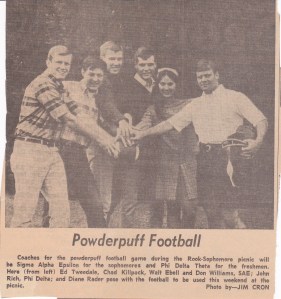
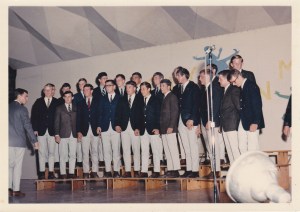
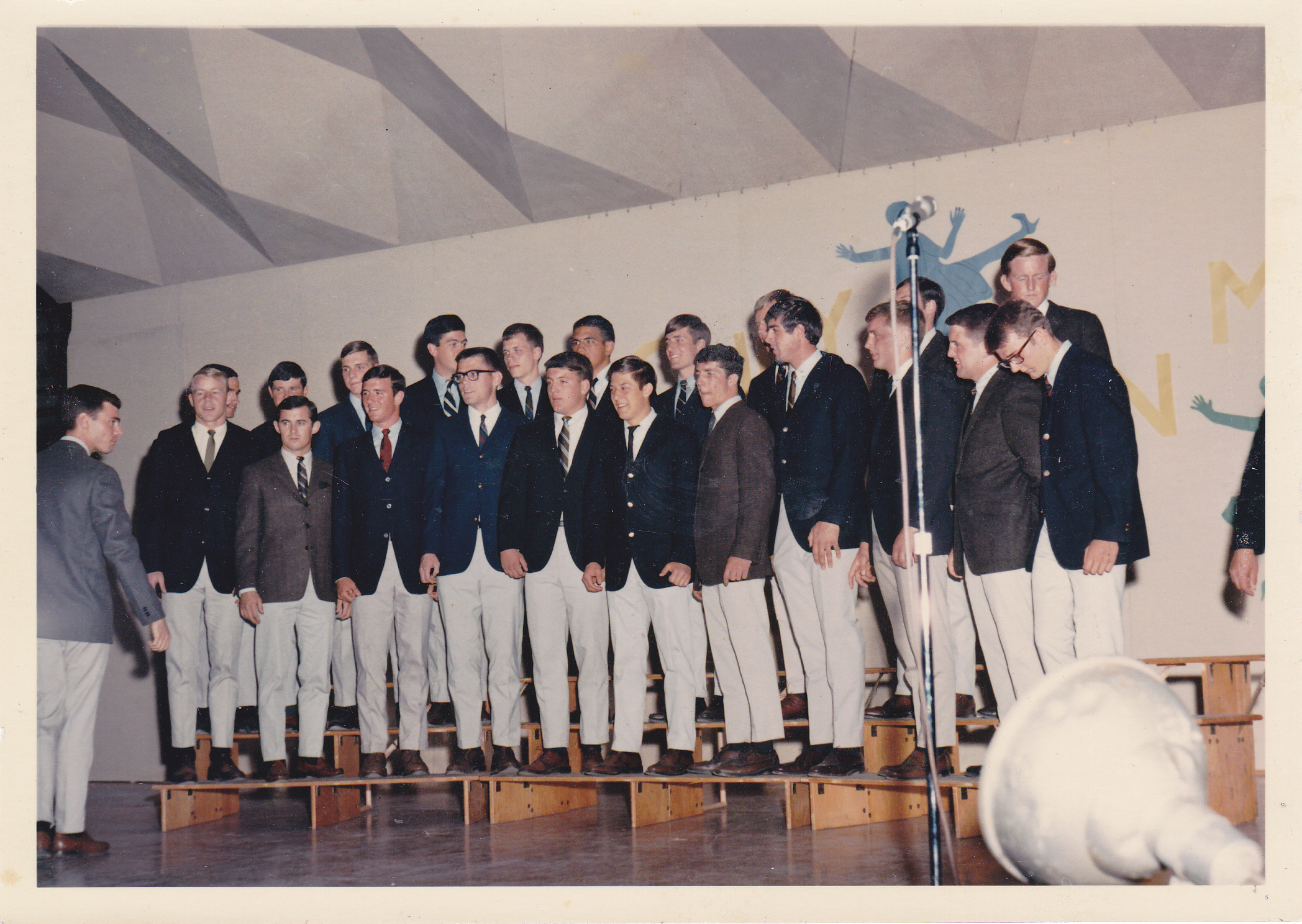
The SAE entry to the IFC sing – Whitney top left and Bartons (Gary and Duane) third and second from right end bottom row)
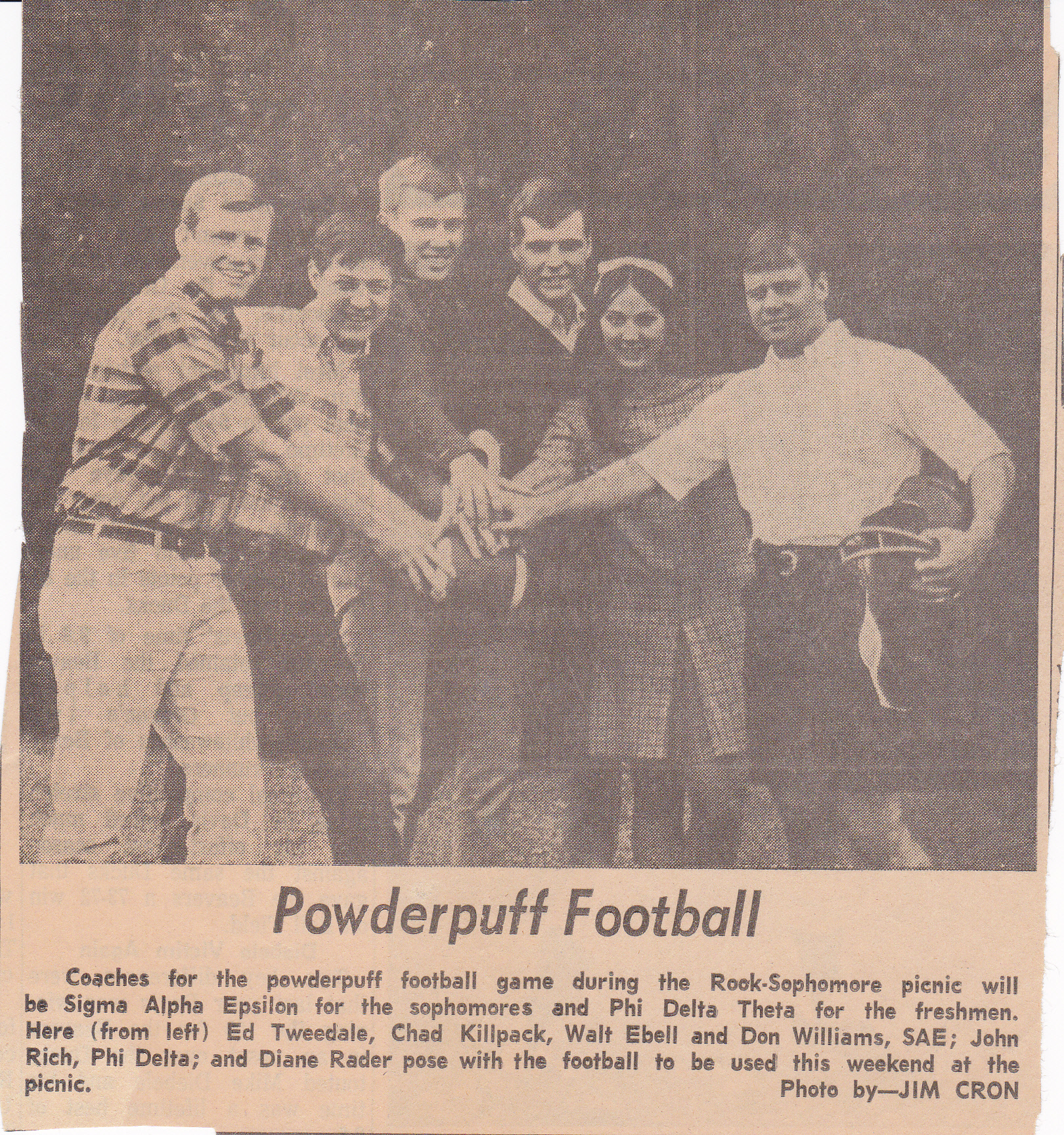
Other campus activities such as the Rook/Sophomore Picnic at which there was an annual Powder Puff Football game, the Inter-fraternity Sing, Joe College/Betty Coed court (see below – it would not be politically correct these days) were popular and had campus-wide participation.
Freshmen coeds had a curfew labeld “Closing.” Larry Rich met his future wife, Mariellen Lorenz, when they were on “the court” for Joe College and Betty Coed at a photo-shoot at the MU in December 1967. They were selected and were married two yeas later and will celebrate their 50th anniversary next year. The couple now lives in Lincoln City. Mariellen, in response to my question about closing for coeds wrote:
“OSU regulated the innocent freshmen women who had to live in one of the dorms on campus their first year. I recall a curfew in the dorms of 11:00 weekdays and Sunday and 1:00 on Fridays and Saturdays. We couldn’t wear pants/jeans/slacks to class until my junior year and the skirts and dresses were cold in the winter! And we didn’t wear shorts anywhere on campus, but very short skirts were the trend.”

Janet Williams and Mariellen and Larry Rich in Lincoln City
Closing, of course, could be easily circumvented by staying out all night and returning to the dorm for breakfast!. One has to wonder the rationale for discriminating by gender on the curfew. Did the OSU Administration think that Rook males were more mature and therefore should have the requirement waived?
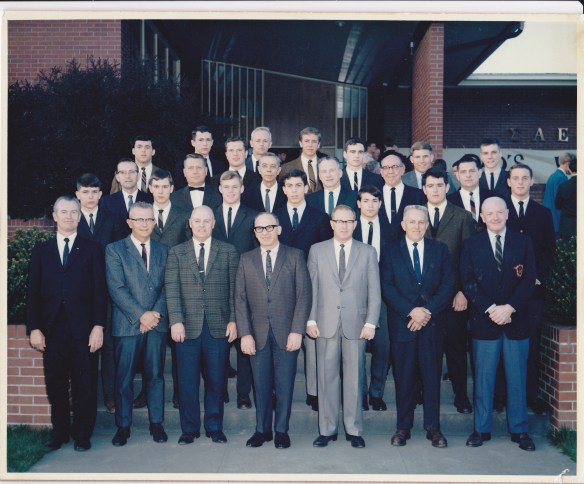
Dad’s Weekend. Larry Rich and his dad, Scooter – third from left bottom two rows and my dad, Duane and me – back two rows on the right
Mom’s and Dad’s Weekends were always a highlight and drew a lot of parents.
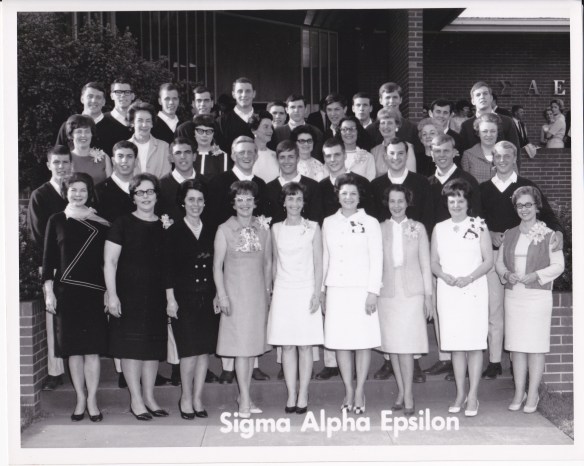
Mom’s Weekend. My mom and I are sixth from the left in first two rows.
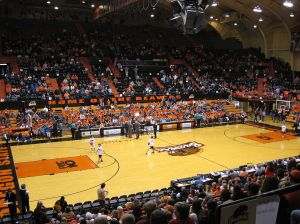
Gill Coliseum was also a concert venue
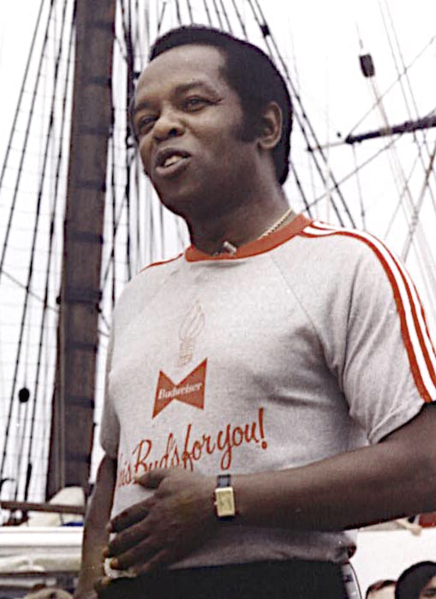
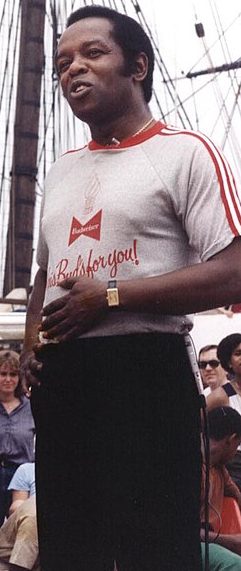
And we went to concerts by such groups as The Mamas and Papas, Three Dog Night, The Association and Lou Rawls (see below) which drew full houses in Gill Coliseum which was converted to an auditorium without great acoustics — we didn’t care……
Rick Gaffney, one of the SAE frat bros, chaired the Sophomore Cotillion events on the weekend when the late Lou Rawls appeared in concert. His concert was not well attended although all who went were thrilled with his performance.
Our class of SAE’s rented a room at the Town House Motor Inn on 4th Street in “downtown” Corvallis for pre-functioning and post-functioning – also because we weren’t yet 21 and could not go to a venue that served alcohol. (The motel is now the University Inn and one can still get a standard room with a king-bed for $70.39 if it not on a weekend with a home athletic contest.)
Gaffney, (who was also a NROTC midshipman) invited Lou Rawls to our party at the motel, after the show, never thinking he’d actually come. When he arrived, we offered him a beer — he asked if we had any “hard stuff.” The only thing other than Olympia Beer in our inventory was Sloe Gin, which made Rawls guffaw.
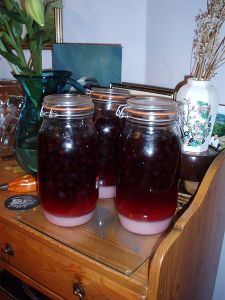
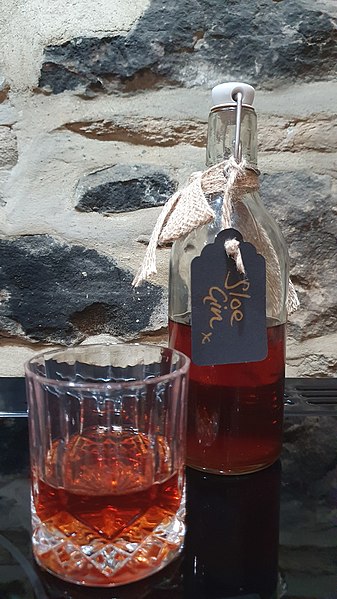
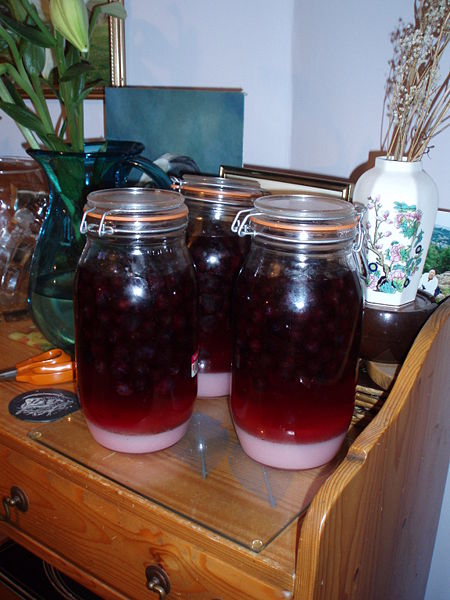
Homemade Sloe Gin
Why Sloe Gin? It’s a “red liqueur made with gin and ……drupes a small fruit relative of the plum. Sloe gin has an alcohol content between 15 and 30 percent by volume.” (emphasis supplied – Wikipedia)
Rick Gaffney relates how he ran into Rawls again at Kona Village Resort where he worked as beach captain in the mid-70’s. He was there with actress Brenda Vaccaro (“Midnight Cowboy”, etc.).
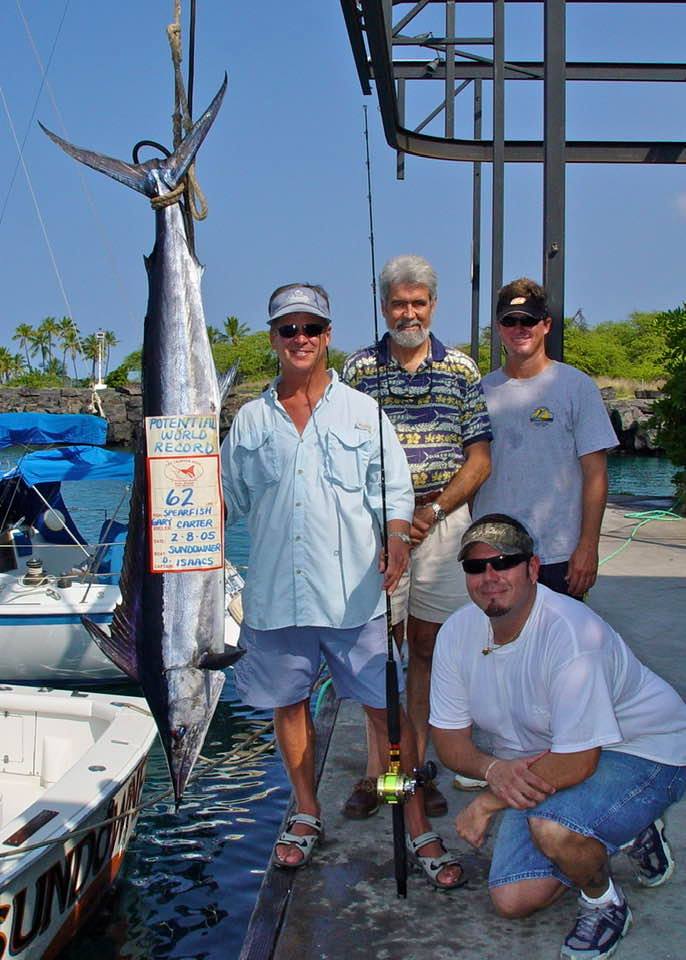
When Rick re-introduced himself and reminded him of the Sophomore Cotillion show he did at OSU, he looked Gaffney right in the eye and said, “Sloe Gin — All you had was Sloe Gin.” They both had a good laugh….. (Gaffney later became the owner of a successful charter-fishing business in the Islands.)
Larry Rich and his date, Mariellen were there and Larry remembers Rawls sporting a fabulous, large diamond-studded ring with the initials “LR” and Rich said that he told the singer if he ever got tired of the ring, he would be glad to buy it “at the right price!”
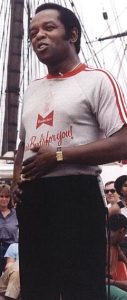
“LR” initials rang a bell
And speaking of Giant Killer stories, Keith (Sweeny) Swensen, another one of the SAE’s there that night, relates another Lou Rawls story involving defensive back, Don Whitney:
“I remember the look on Don Whitney’s face when he came out of the bathroom singing a Lou Rawls’ song only to walk right into Lou Rawls, himself. Whit turned bright red but then Lou complimented him on his singing. After that, I don’t think Whit said a word for the next 10 minutes. He just sat there with a shit-eatin’ grin on his face.”
One of the good things about OSU, which even now is still not a large school with 2017 enrollment (grad and undergrad) of 30,400, was that it was a closely-knit campus – you knew a lot of people regardless of whether you lived in a frat, a dorm or a co-op. This is in contrast to schools we played that year such as UCLA – 44947, USC – 45,500 and Washington – 45,600 (enrollment figures are from 2017).
And most of the Beaver athletes did not live off campus or in their own athlete-only dorms. They were an integral part of campus life – you attended classes with them, saw them at the Memorial Union and lived with them. (Maybe during the off-season, you might even raise a discrete mug with them at Prices, Don’s Den or the Peacock!)
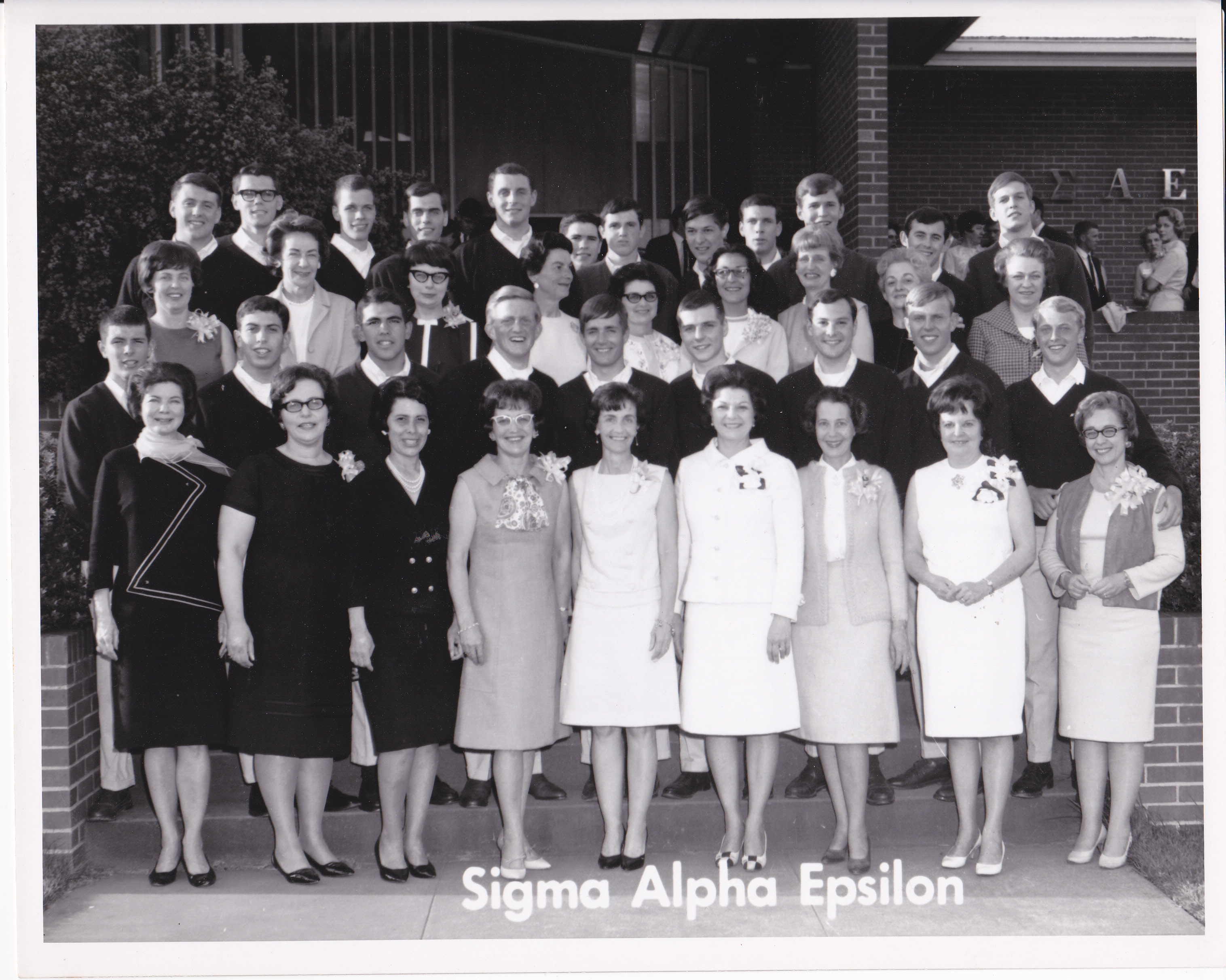
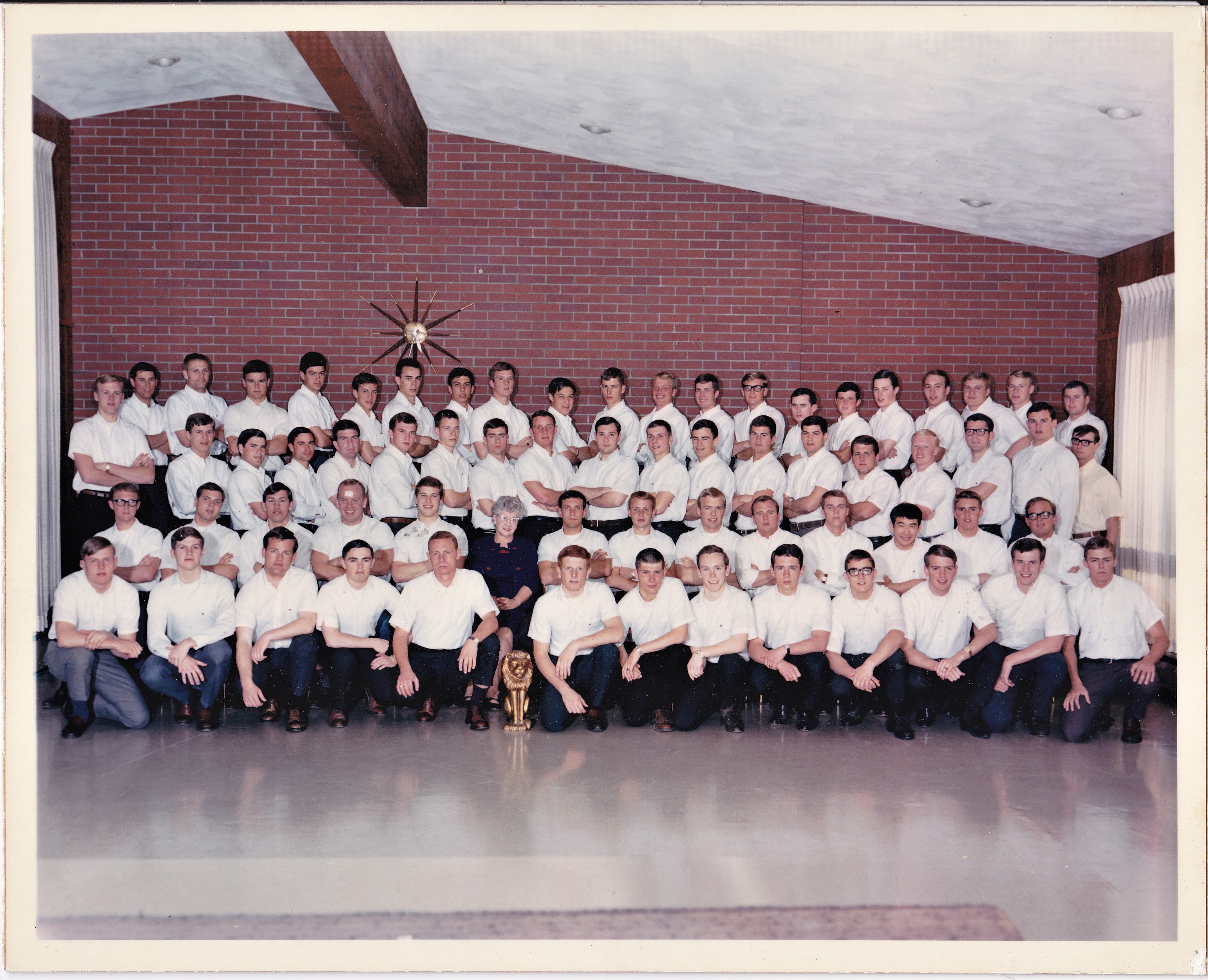
For example, in the SAE fraternity, I lived with the following members of the Giant Killer Team – Larry Rich, Don Whitney, Roger Cantlon, Duane Barton, Jess Lewis, Jim Blackford, Don Welch, Chris Wahle, Clyde Smith and Jim Scheele. In our freshman year, Rich and Whitney got up each weekday morning at 7:00 A.M. and did “rook chores” at the frat each morning like the rest of their classmates. And we were not a jock house.
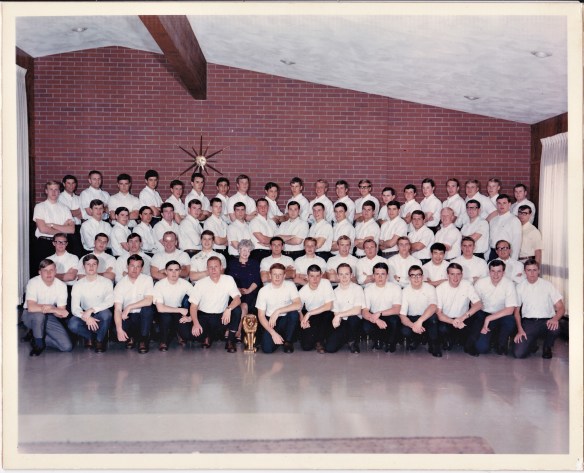
The SAE House in 1966 – (Scheele 3rd right back row – Blackford, Lewis, Whitney – back row right- Barton 3rd row five in from right – Wahle second row fourth from left with bandage! – ) Rich, Smith, Welch and Cantlon not present)
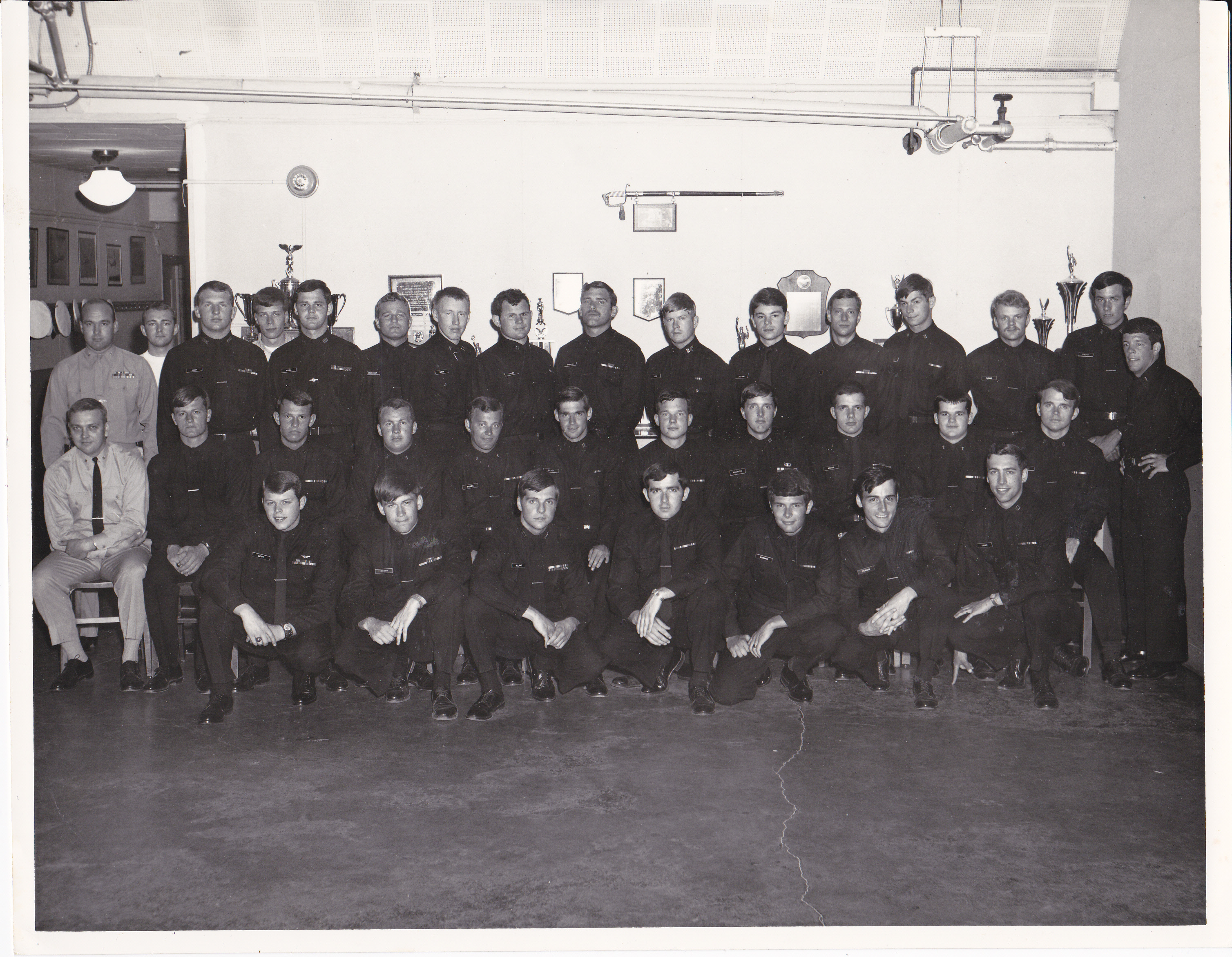
To further illustrate the point, as a member of NROTC, I would see Giant Killers Duane Barton and Billy Main (and later Rus Jordan) at drill each Tuesday for an hour when we paraded around the concrete parking lot – they were upper-class midshipmen. Midshipman and ROTC cadets were also required to wear our military uniforms to class one day each week and we did so without incident notwithstanding the growing national agitation about Viet Nam. (One would often cross the street, however, to avoid having to salute an ROTC officer……)
That mood was to change in my senior year when the NROTC unit was firebombed. Fortunately, no one was injured. In an incident that still makes me chuckle, I also remember walking into a Russian History Class with my girlfriend who was also enrolled in the course. It was the day of the week that 1/c midshipmen were required to wear uniforms on campus. We were somewhat disruptive because we tried to slink in but were 15 minutes late and it was not a large classroom. The professor stopped his lecture looked at me in my uniform and sarcastically stated, “And to think that the defense of our country is going to lie in the hands of people like you……..”

1970 NROTC First-Class (Senior) Midshipmen. (Note only males at that time. Women were first enrolled in 1972).
And as a freshman, I sat next to starting safety, Mark Waletich, in CK Smith’s “History of Western Civilization 101” class – one of those required courses in large (for OSU) classrooms with about 75 students. Dr. Smith, in order to take roll to see who was skipping class (I thought that didn’t happen once you reached college) had us sit in assigned seats – in this case in reverse alphabetical order.

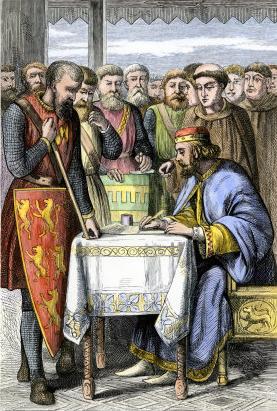
King John signs the Magna Carta
So I sat right next to Mark in the first row in front of the professor in a morning class. In the first class, Waletich said “hello” and cheerfully asked me to nudge him if he fell asleep – he did a few times (evidently not very interested in the Magna Carta…..) and I would always give him a friendly elbow.
While we as college students attended class, hit the books, went to keggers and house dances and were thrilled by the amazing OSU Football Team, what was going on in the world?
In 1967, the average new house sold for $14,975 and the average income was $7,844. Annual full-time tuition, room and board at OSU was about $2,500 although for our four-year after-graduation obligation, the Navy paid tuition, books and a $50 monthly stipend. (Main and Barton would have a six-year requirement because they opted for Naval aviation.)
A McDonald’s hamburger was 39 cents. In 1967, the Dow Jones Average peaked at 973 with the low point at 786 and inflation was at 2.8%. The most popular song was “To Sir with Love” by Lulu which was at the top of the charts for five weeks. Other significant events included:
Ultra-conservative generals in Greece fear results of the elections scheduled for May. A coup led by Colonel Giorgios Papadopoulos, takes power. (This will be the last time most US citizens see the name “Papadopoulos” until Trump campaign aide, George Papadopoulos is indicted for lying to the FBI in 2018!)
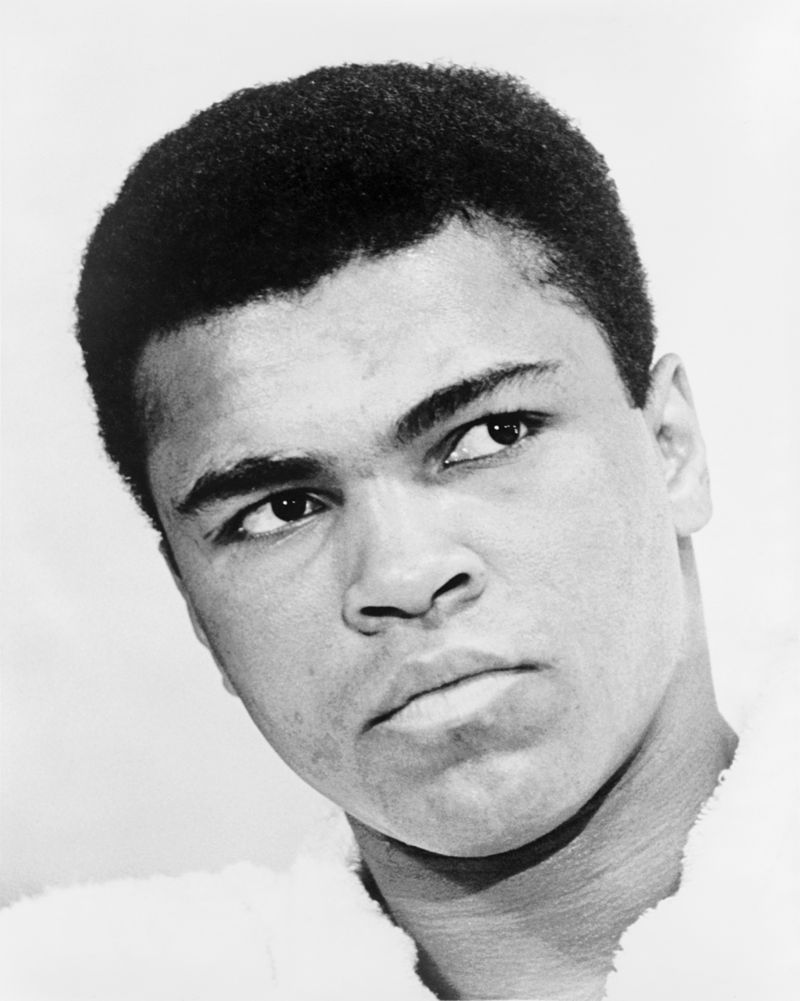
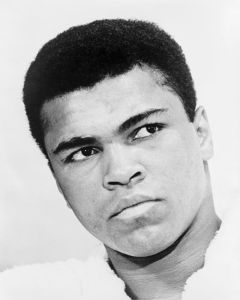 Boxing champion Muhammad Ali has refused induction into the Army and is stripped of his boxing title. He is then indicted for refusing induction into the US Army.
In San Francisco’s Golden Gate Park approximately 30,000 take part in a “be-in.” Among the participants are Allen Ginsberg, credited with creating the term “flower power,” and Timothy Leary, fired Harvard professor and LSD guru. California’s governor, Ronald Reagan, meets with FBI agents for information on Berkeley campus radicals.
 The US Freedom of Information Act becomes official. To withhold information, government agencies must show its need to be classified.
The Monterey International Pop Festival opens in California and is attended by over 200,000. Featured are Janis Joplin, the Jefferson Airplane, the Grateful Dead, Jimi Hendrix, the Who and Otis Redding.
The Soviet Union has been under moral pressure from North Vietnam to help their struggle for national liberation. It signs an agreement with Hanoi to send more aid.
There is rioting over race in major cities including Buffalo, Memphis, Detroit, Newark and Cairo, Illinois. Thurgood Marshall becomes the first black justice of the US Supreme Court. In Cleveland, Carl Stokes is elected mayor – the first African-American mayor of a major US city.
In New York the musical Hair premiers Off-Broadway. (Admission was $8.50.)
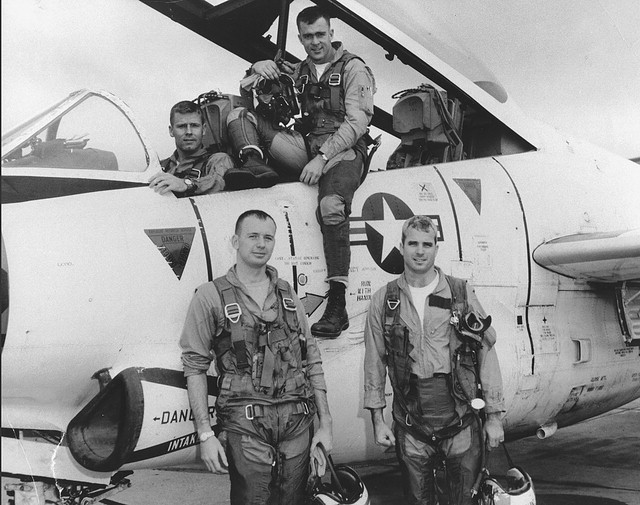
John McCain bails from his damaged plane and falls into Hanoi’s Truc Bach Lake. He is viewed as a heinous criminal, beaten, bayoneted in the foot and groin and taken away for imprisonment and more primitivity and torture.

John McCain (front right) – a hero (in just about everybody’s book…)
Richard Nixon claims that the US must pursue the war in Vietnam to a “successful” conclusion or risk a Third World War. Some 474,300 US soldiers are now in Vietnam.
(Excerpted from Macrohistory and World Timeline http://www.fsmitha.com/time/1967.htm Author Frank Smitha)
Now one thing that is a real misperception and deserves clarification is that the total focus of the 1967 Giant Killers season was the 3 to 0 victory over No. 1 ranked USC. And while it’s true that this game (including the amazing tackle by Jess Lewis after OJ broke away) was the zenith of the season, the story transcends this one game as I will try to illustrate in the next two blog posts.
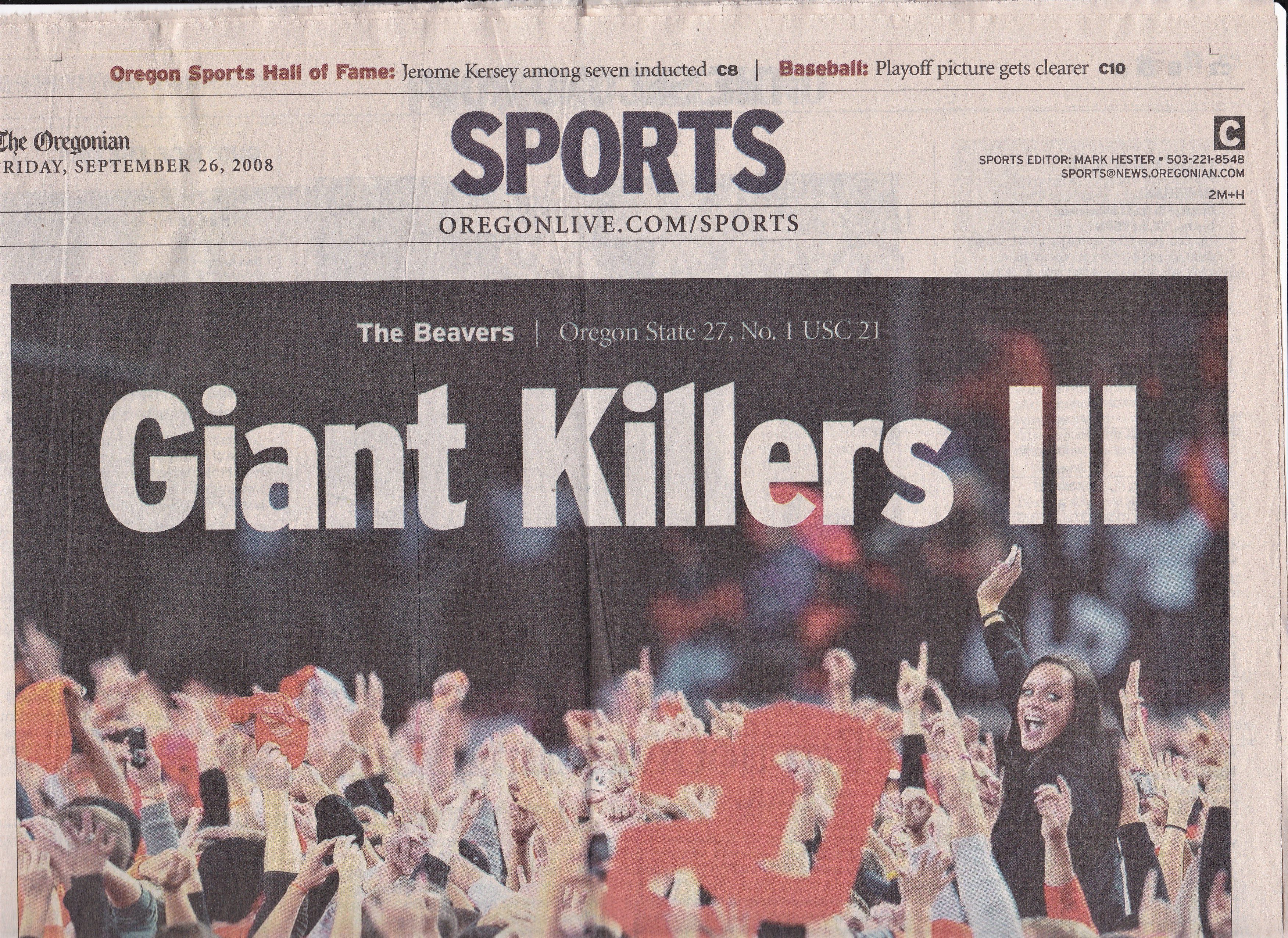
This misperception was reinforced by Portland newspaper, The Oregonian (which should have known better) when the banner headline on the September 26, 2008 Sports Page shouted “Giant Killers III.” This was after the Beavers beat No. 1 rated USC 27 to 21 at Reser Stadium. The accompanying article also asserted that Giant Killers II was the October 25, 2006 game in Corvallis when OSU beat the third-rated Trojans 33 to 31.

Now as you can see by the ticket stub below, I was at the 2006 game which was outstanding. With OSU leading 33 to 10 at the end of the third quarter, USC fought back and scored a touchdown with seven seconds to go to make it 33 to 31, but the Beav’s Jeff Van Orsow knocked down the Trojan’s David Booty’s pass for a two-point conversion as time ran out.
And that was an incredible victory since it had been 39 years since the Beaver football team had beaten a team ranked third or higher in the national polls – in the aforementioned Giant Killers’ 3 to 0 victory. On that fall 2006 victorious afternoon, as we hit the corner of 29th and Harrison Street in the ensuing traffic jam, we saw SAE frat boys standing on the corner holding beer bottles and a big sign that said, “You Honk. We Drink!” (We honked…..)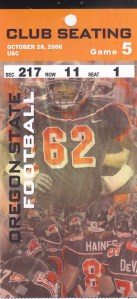
Now admittedly both of those games were celebrated victories especially given the woefully long drought in winning football seasons, but the Giant Killer story was and is much, much bigger and more compelling than the single victory over a ranked USC team. The next two posts on Thebeerchaser will attempt to explain why – not a very challenging position to argue.
And by the way, we should not forget the Civil War Game in 1967 – usually the pinnacle of the season in a contest that commenced in 1894 and is one of the oldest football rivalries in the nation. Oregon State had won the last three and traveled to Eugene for the christening of the new Autzen Stadium. Many thought that the outcome was a foregone conclusion given the Beavs spectacular wins and national ranking versus the Ducks 2 win – 8 loss season to that point.
In a game that will be described in more detail in the next post, Oregon State was losing 10 to 0 in the fourth quarter and had to come from behind to win 14 to 10. Had the Beavers not had the fortitude to “reach back,” the season would not still be discussed and be the focus of narratives such as this one fifty-one years later.
 But the Giant Killer legend lives on and as Blakely states in his website, “The Giant Killers have become a rich and precious gem.” And it should be restated, that to fully appreciate the veracity of that statement, you should visit (and spend a lot of hours….) at his website. http://osu67giantkillers.com/
To conclude this narrative, I offer another recent statement from former newspaperman, Chamness, who used his still good writing skills to sum it up quite well:
“As a Barometer reporter we covered events like protests and controversies. It was depressing! And then the ’67 Giant Killers came along and they were like an ‘Alka-Seltzer’ bringing welcome relief from the drudgery of reporting the hard news.
I don’t think any of us freshman really understood the magnitude of what our football team accomplished that season; and I’m sure none of us even remotely thought that we would be reminiscing and celebrating that season some 50 years later! In the world of OSU football, the Giant Killers inspired us to ‘keep hope alive’ . . . season . . . after season . . . after season . . . after season . . . . . ”
Cheers!



















.jpg)


