
Welcome back to Thebeerchaser. If you are seeing this post through an e-mail, please visit the blog by clicking on the title above to see all of the photos at the end of the post and so the narrative isn’t clipped or shortened. (External photo attribution at the end of the post #1)
Since the pandemic, it’s been discouraging to see the number of hospitality establishments that have struggled or just closed permanently. Exacerbating the situation, is the hardest hit of these enterprises has been the independent or small business owners.
Not that the corporate chains have been untouched by labor shortages, supply-chain issues or just profitability, but they have far superior reserves. After having it on my list for years, I had lunch at Gino’s Restaurant and Bar in Sellwood, just south of Portland.
And I’m happy to report that Gino’s appears to be thriving, just as Huber’s, (see my recent Beerchaser review) another iconic Portland establishment that’s served loyal patrons for longer than Gino’s, but has some similarities which make both eateries and bars worth visiting – and I might add – “again and again!”
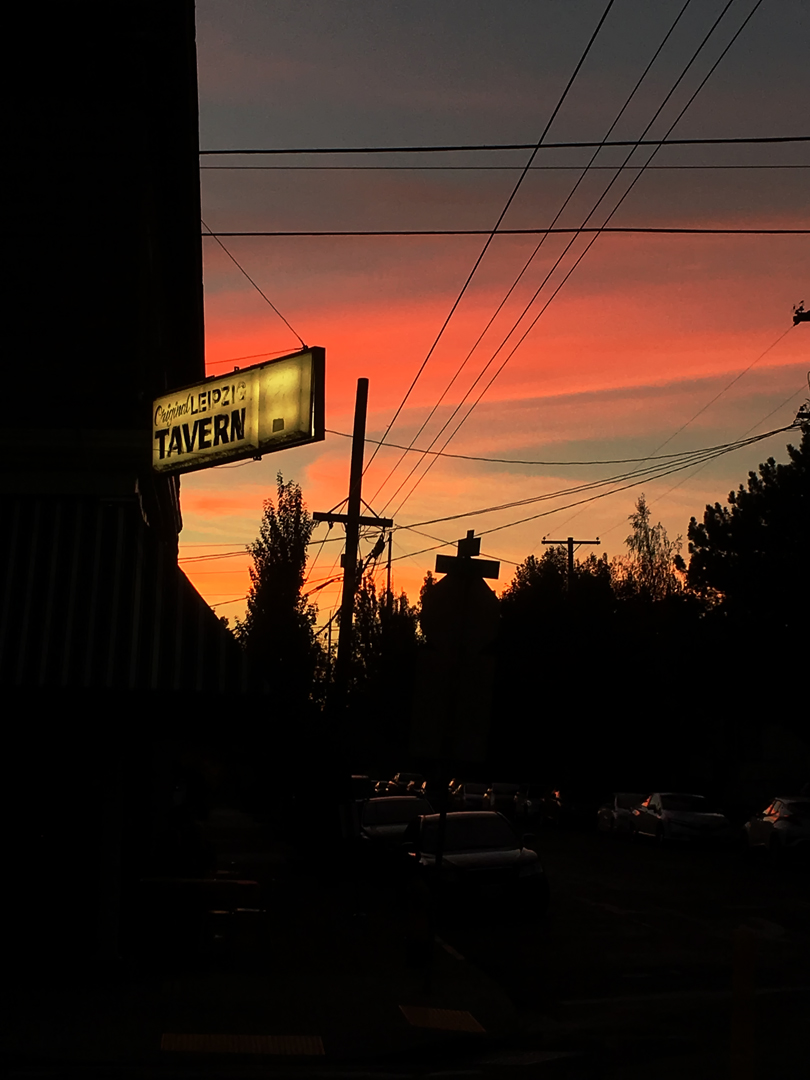
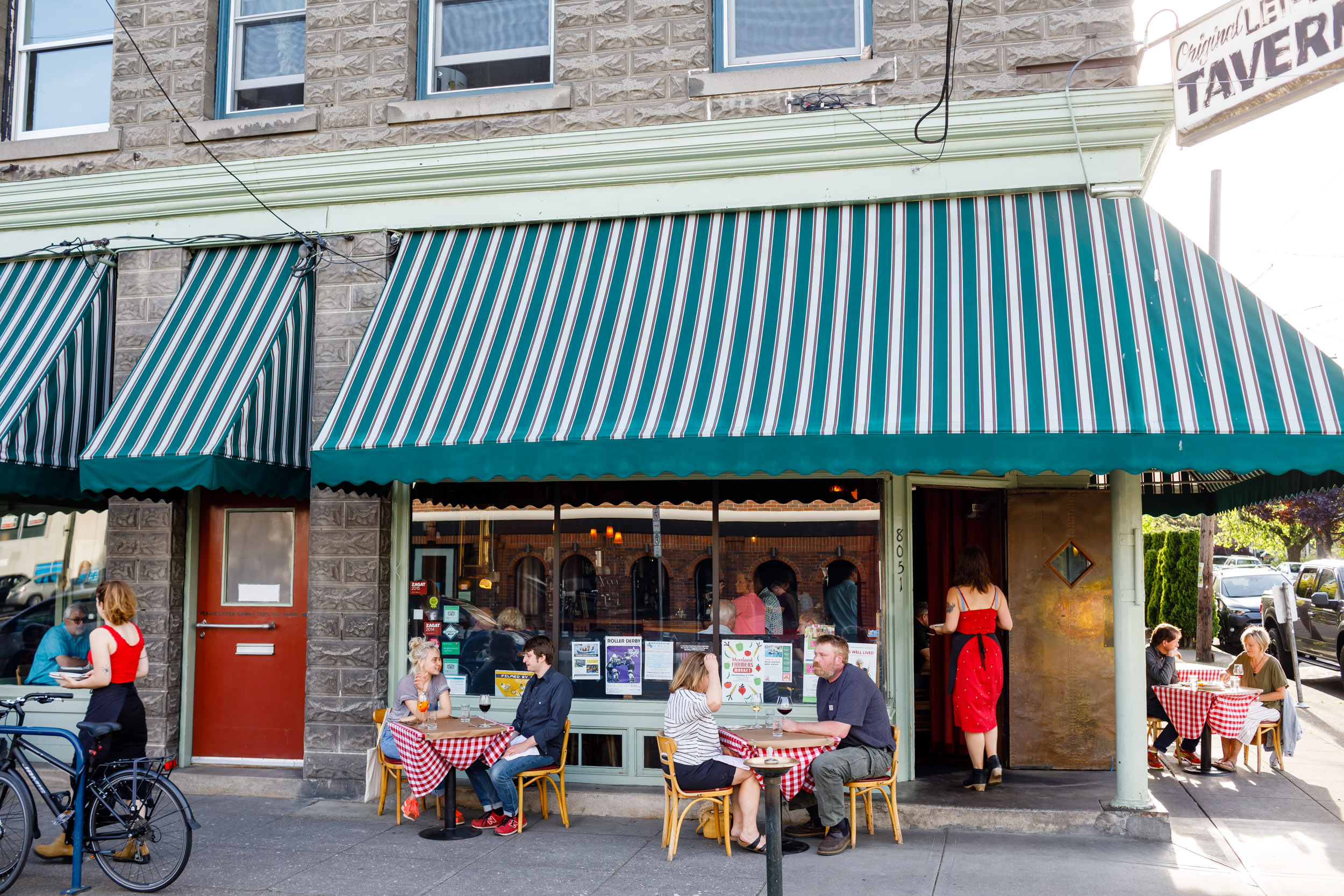
The photo above shows the name as “Original Leipzig Tavern” and I will explain that apparent discrepancy below.
Oh, the History!
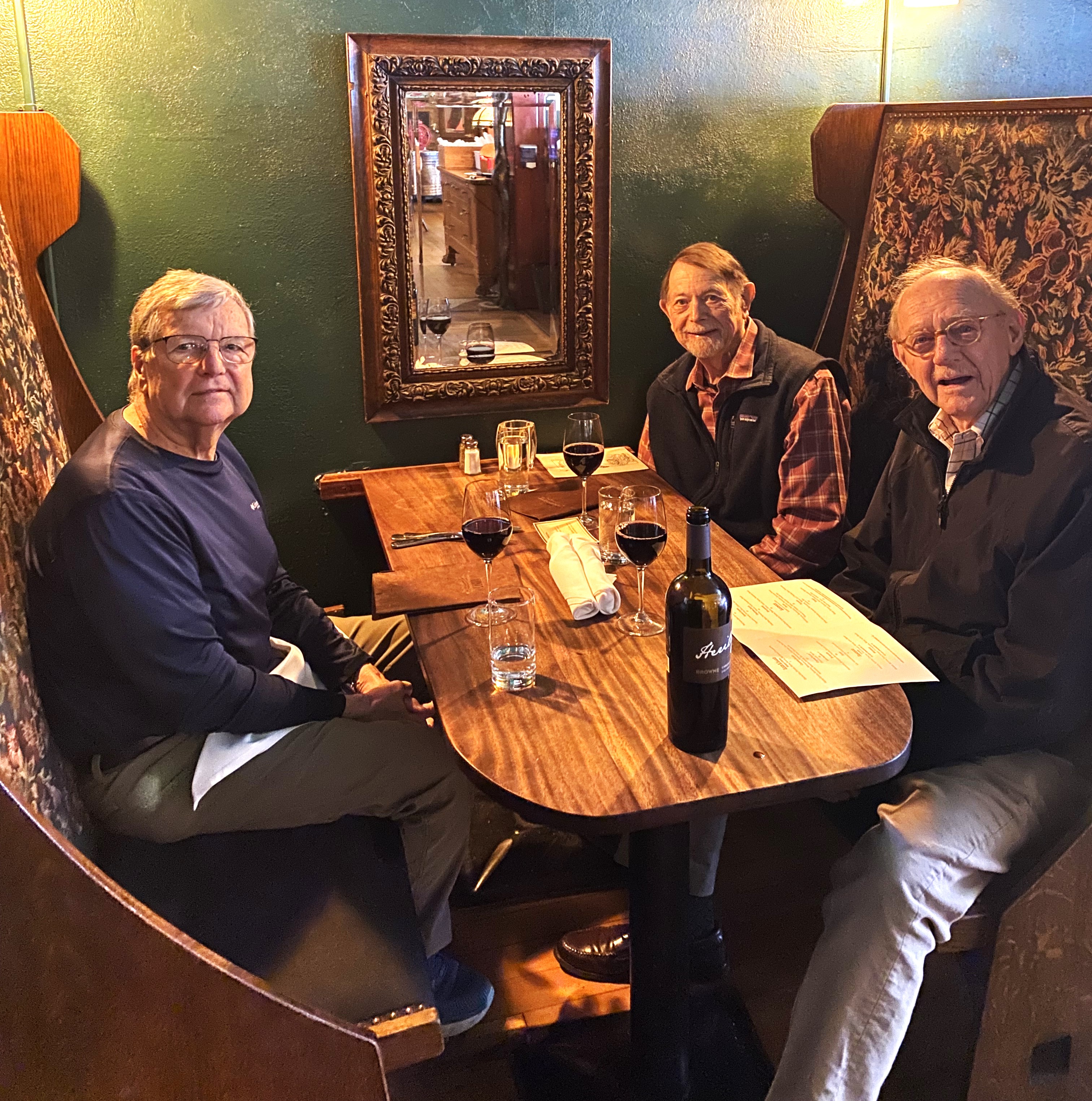
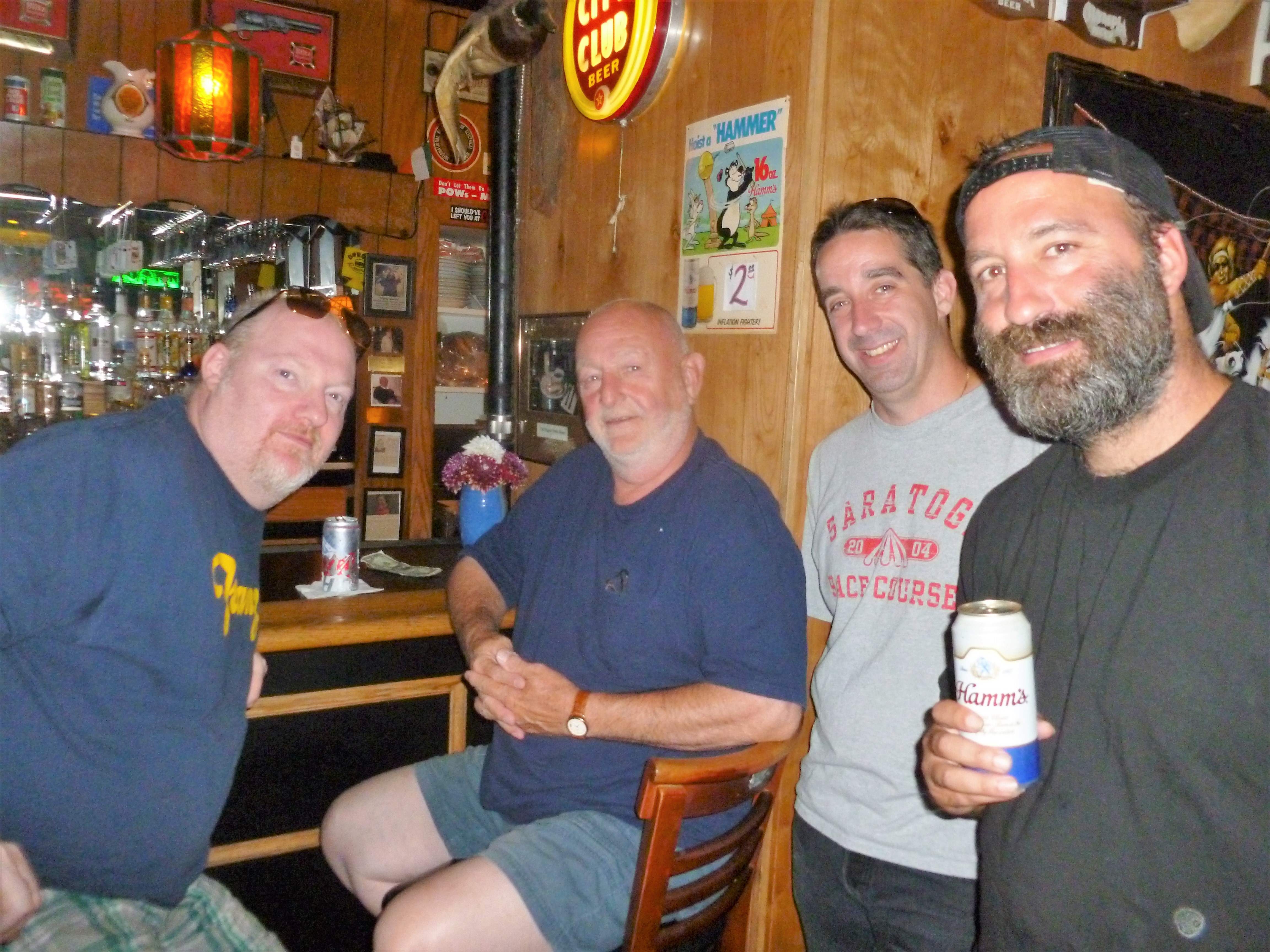
I was thrilled to have a reunion after many years with my Portland State University graduate school professor and advisor, Dr. Walt Ellis and his colleague in PSU’s Hatfield School of Government – Dr. Doug Morgan in mid-June.
I’ll relate more about the outstanding careers and reputation of these two gents below, but first a little about the rich history of this Sellwood-Moreland Neighborhood treasure.
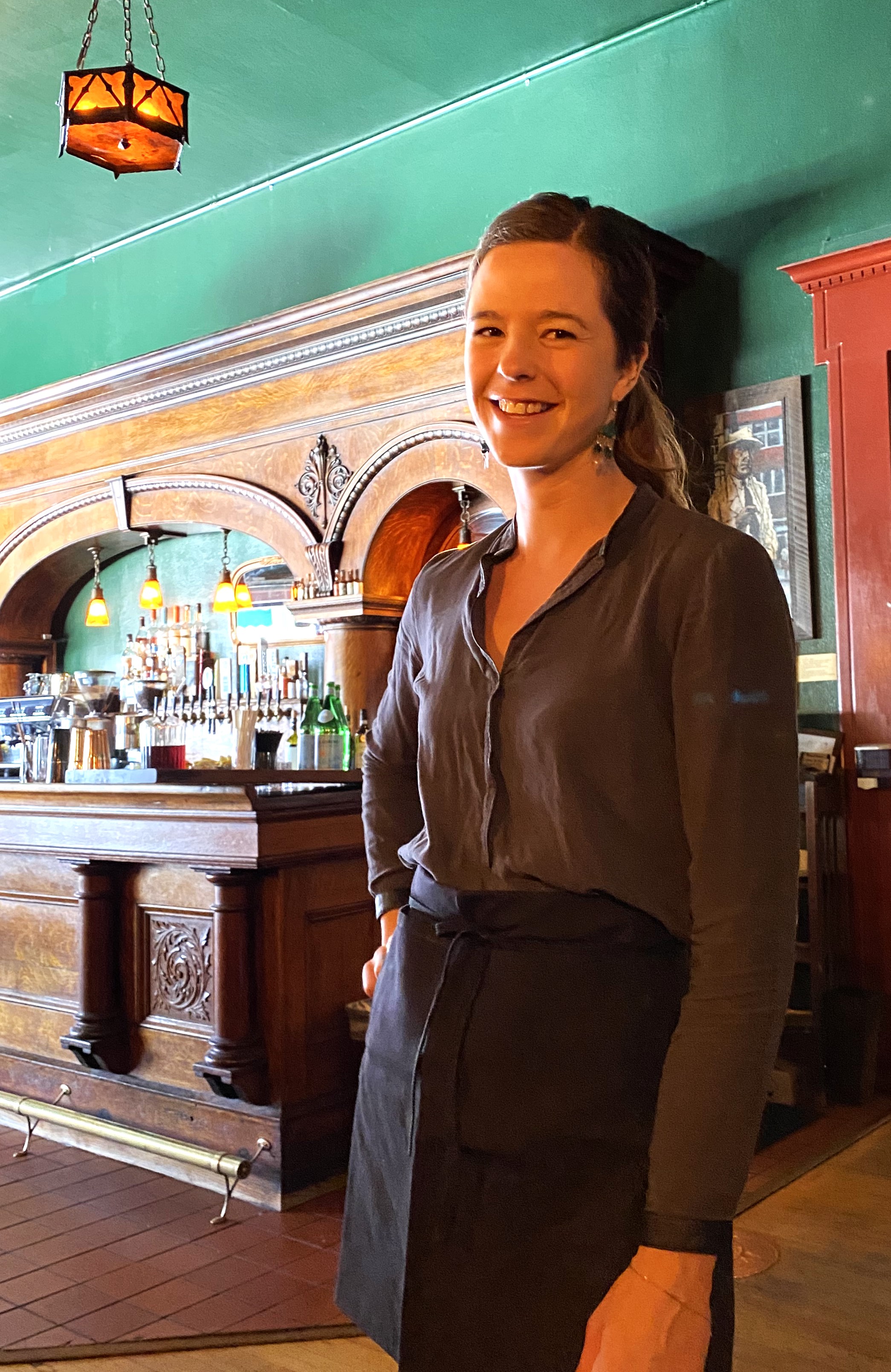
Our visit was enhanced by our wonderful server, Natalie, who right from the start, showed the same attributes of Gino’s staff as described in this review from Trip Advisor in November, 2023:
“This is a wonderful place to eat. Often busy and you may need a reservation. Staff are very friendly and professional, attentive without being intrusive, fast service, always with a smile. Food is excellent. Cocktails and beer, wine list is extensive, appropriate and connoisseurs won’t be disappointed. Go and enjoy.”
Followers of this blog might remember the name “Accaurdi family” as they were the original owners of Portland’s Old Town Pizza – opened in 1974. Adam Milne, the current owner, first visited when he was nine and subsequently purchased it in 2003.
As the review in my 2019 Thebeerchaser post quoted:
“It was in the historic Merchant Hotel in Old Town and a hub for like-minded people with a radical agenda. It stood as a beacon for the local community; a place to break bread and enjoy your neighbor.”
You will recognize the same theme in Gino’s history.
What is now Gino’s, actually goes back to 1924, when it was opened as a confectionary. The establishment has had multiple names and been in more than one location since that time. The most comprehensive account is a wonderful article, originally published in 2023 in the Sellwood Bee:
“In the summer of 1924, Peter and Helen Leipzig finally attained their lifetime dream….(they) purchased the well-known confectionery store at East 13th and Spokane from Mr. Brink, and are now in possession….
‘The Leipzig’ was seen as the first coffee shop and lunch counter in Sellwood.” (#2)
Then came the Accuardis…
According to one apparently knowledgeable writer in a May 2008 Yelp review:
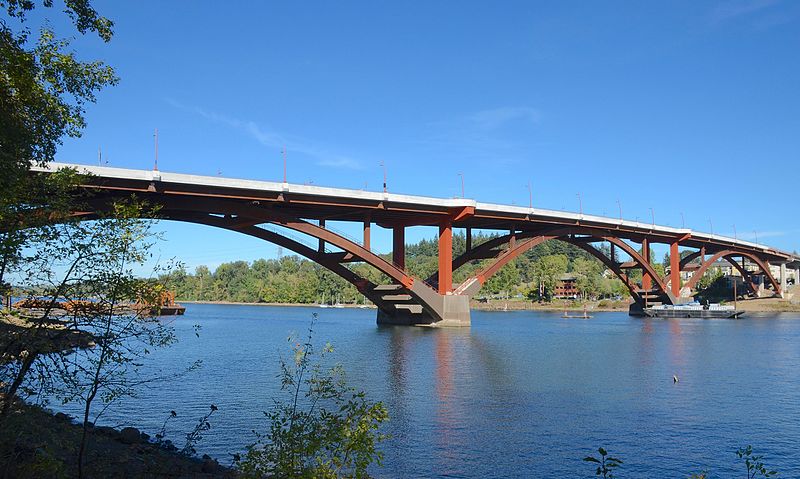
“Within Sellwood itself, stood a bar known as the Leipzig, and for years this was one of many watering holes on the southeast side near the bridge. Years later, the original owner would sell the Leipzig to its current owners, with one caveat, the Leipzig sign was to remain, and so it does to this day.”
There are a number of accounts as to the name issue – Gino’s versus The Leipzig Tavern – according to current owner, Gino Accuardi, in our phone conversation detailed below. He said that one of the senior members (obviously unmarried) of the Leipzig family was the Archbishop of the Archdiocese of Portland.
“He was very irate when the confectionary turned into a bar because he was against drinking.” (#3)
The article in the Sellwood Bee continues:
“Marc and Debby Accuardi bought the Leipzig Tavern in 1996, opening “Gino’s Restaurant and Bar next door”, and using the old Leipzig Tavern as an additional bar for their customers. Much as Peter and Helen believed in back in 1924, they built a place ‘where friends and neighbors could gather to enjoy quality food and wine’”.
I had a very nice phone chat with Gino, who picked up the phone when I called for additional information. Our conversation started like this:
Gino: “Gino’s Restaurant and Bar. This is Gino.”
Beerchaser: “You mean the Gino?”
Gino: “Yep, my grandfather named this place after me when I was twelve. Since I was from a third – no I guess a fourth-generation restaurant family, I guess I knew I was going to own a restaurant someday.”
“I’ve heard many versions of why the Leipzig sign is still there, but keeping it just made common sense. It has a great legacy.”
The Bar Section
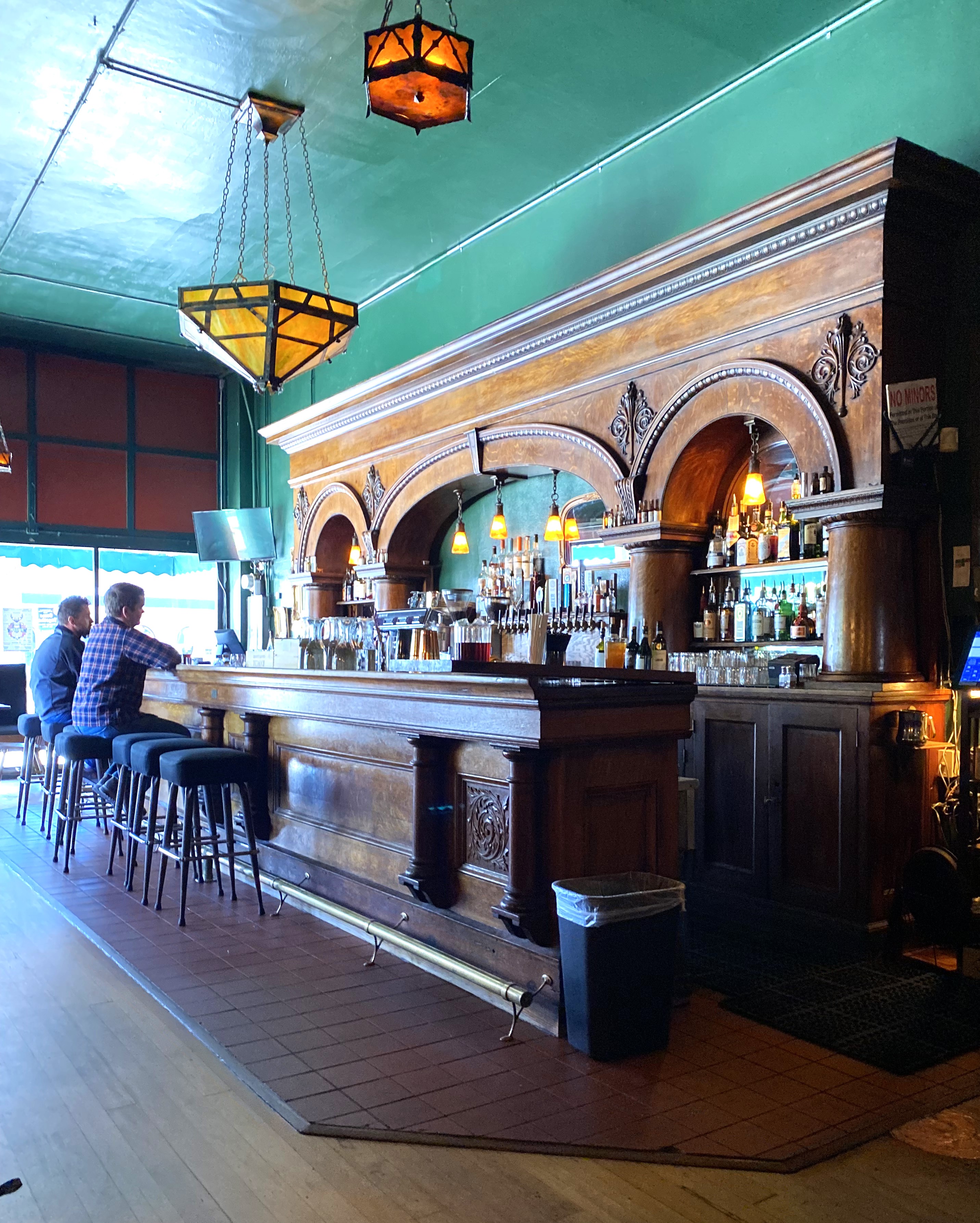
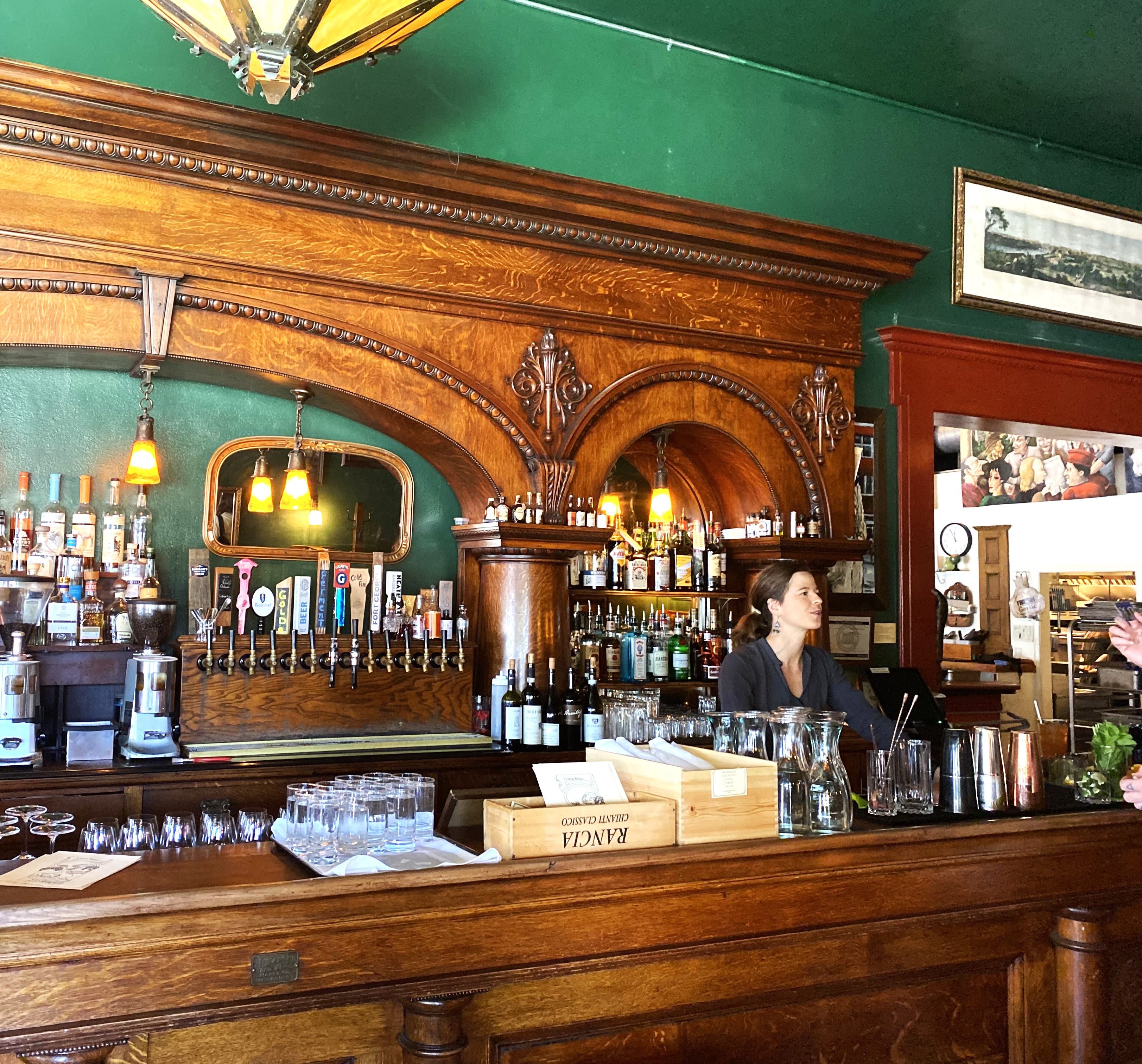
The establishment is divided into two distinct sections. One walks into the bar which has an older-time ambiance including a beautiful backbar and a number of booths. This is aptly described by Willamette Week in their 2019 review:
“Gino’s survives as a Corleone-fueled fever dream simmering in old country charm. The mahogany-lined restaurant sits underneath signage advertising the long-dead Leipzig Tavern, and serves inspired renditions of defiantly unreconstructed Italian classics…..
Today the attached restaurant is known as Gino’s. The bar inside was salvaged from a Chicago warehouse by the current owner and adds a more authentic old-world touch to the atmosphere of the bar (the brass seal from the manufacturer is still on the bar today).” (emphasis supplied)
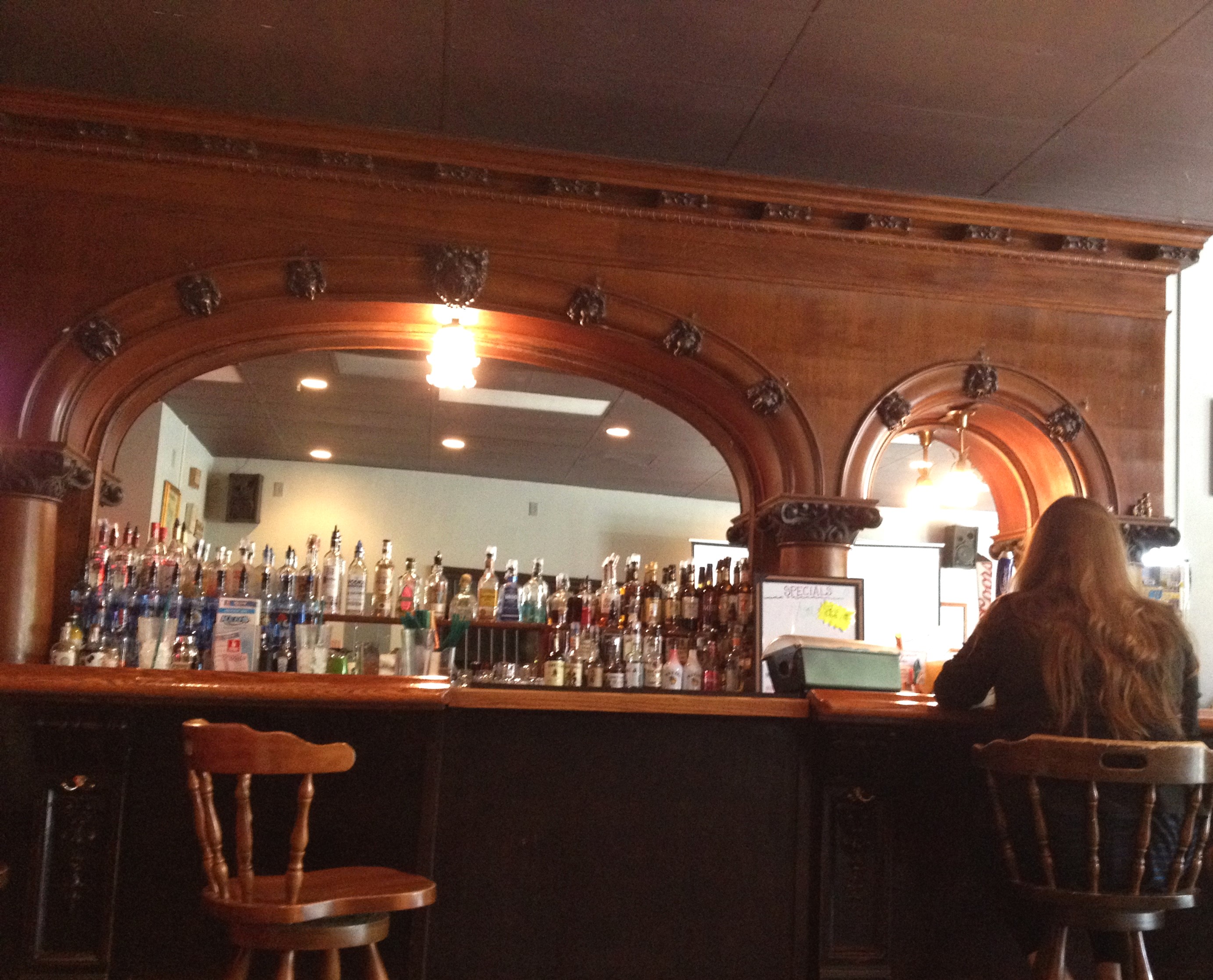
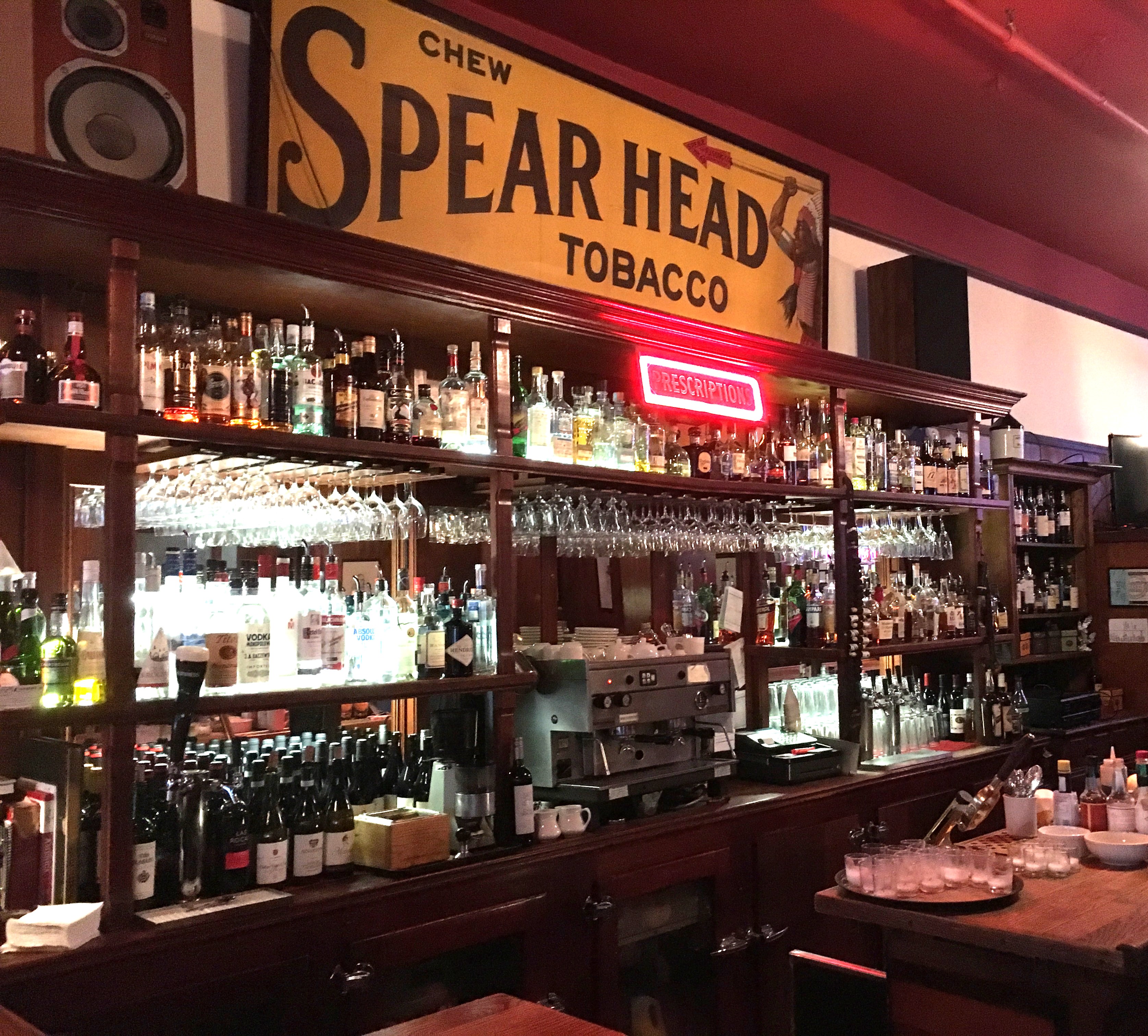
This touch harkened me back to some of the great bars and backbars in both Oregon and the western US where I have Beerchased.
Take a look at these Portland area all-stars from my past visits – clockwise from left to right: McNaulty and Barry’s – Oregon City, the Double Barrel, Buffalo Bills – Beavercreek, Cassidy’s Restuarant and Bar, Hubers Cafe and Multnomah Whiskey Library
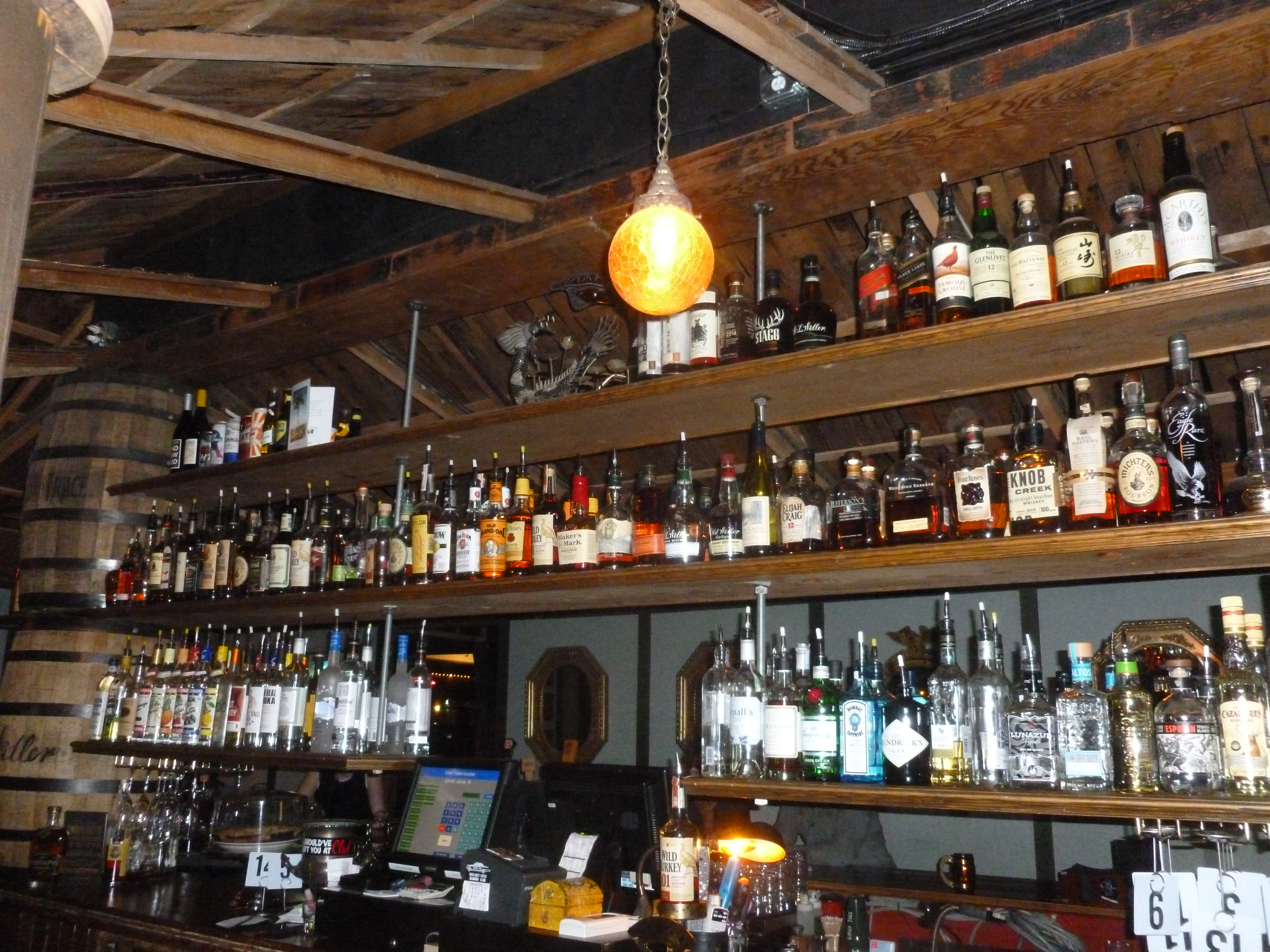
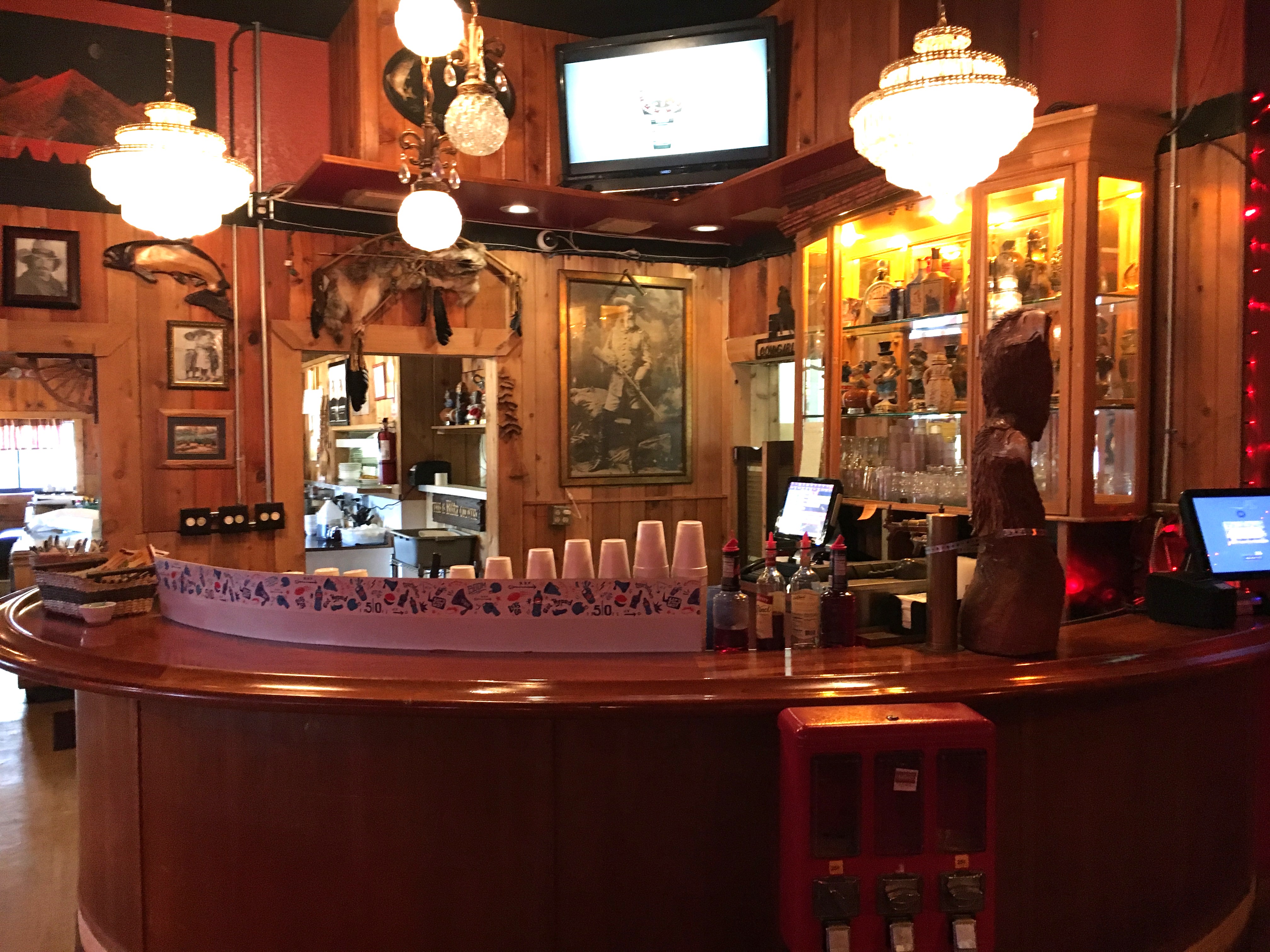
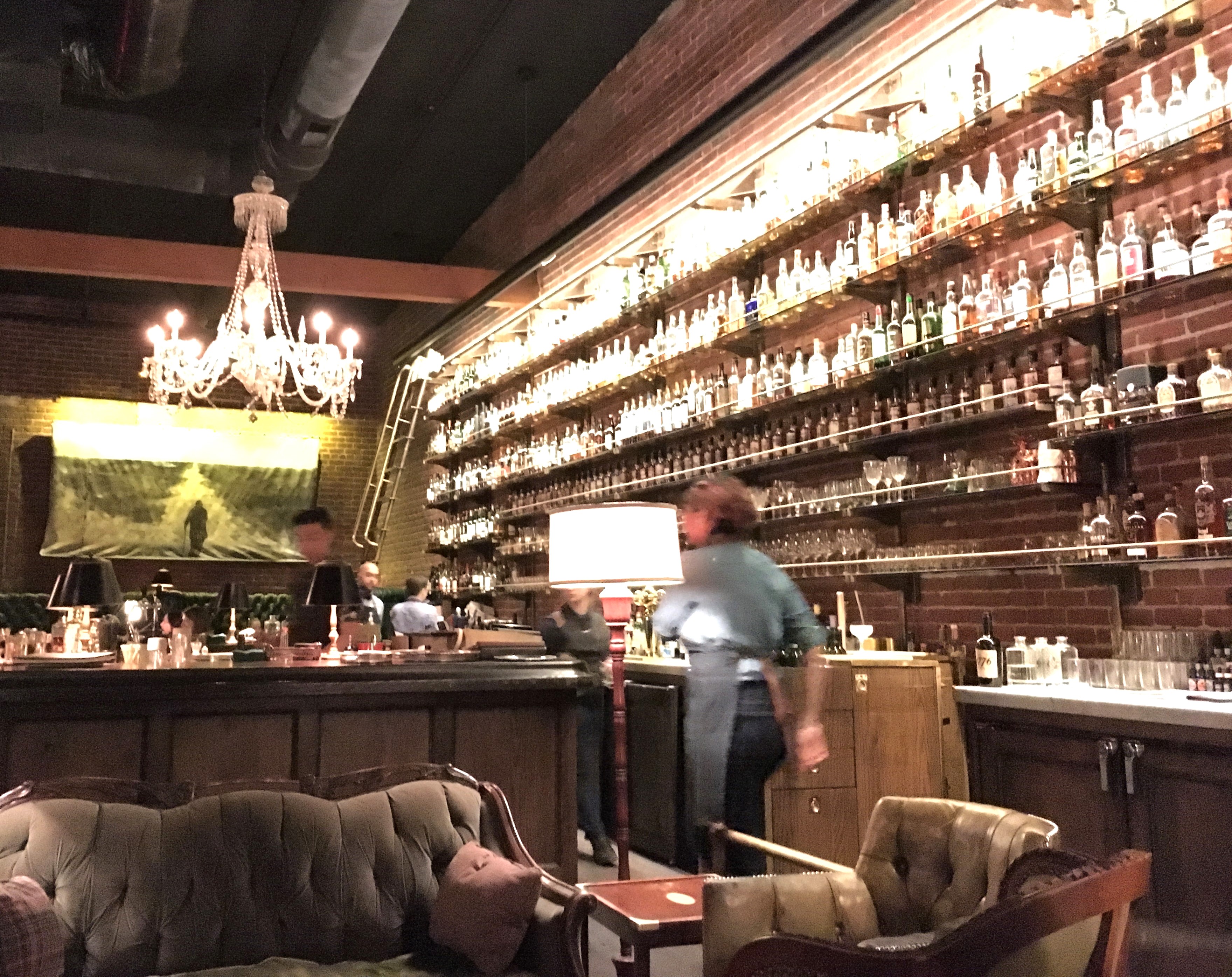
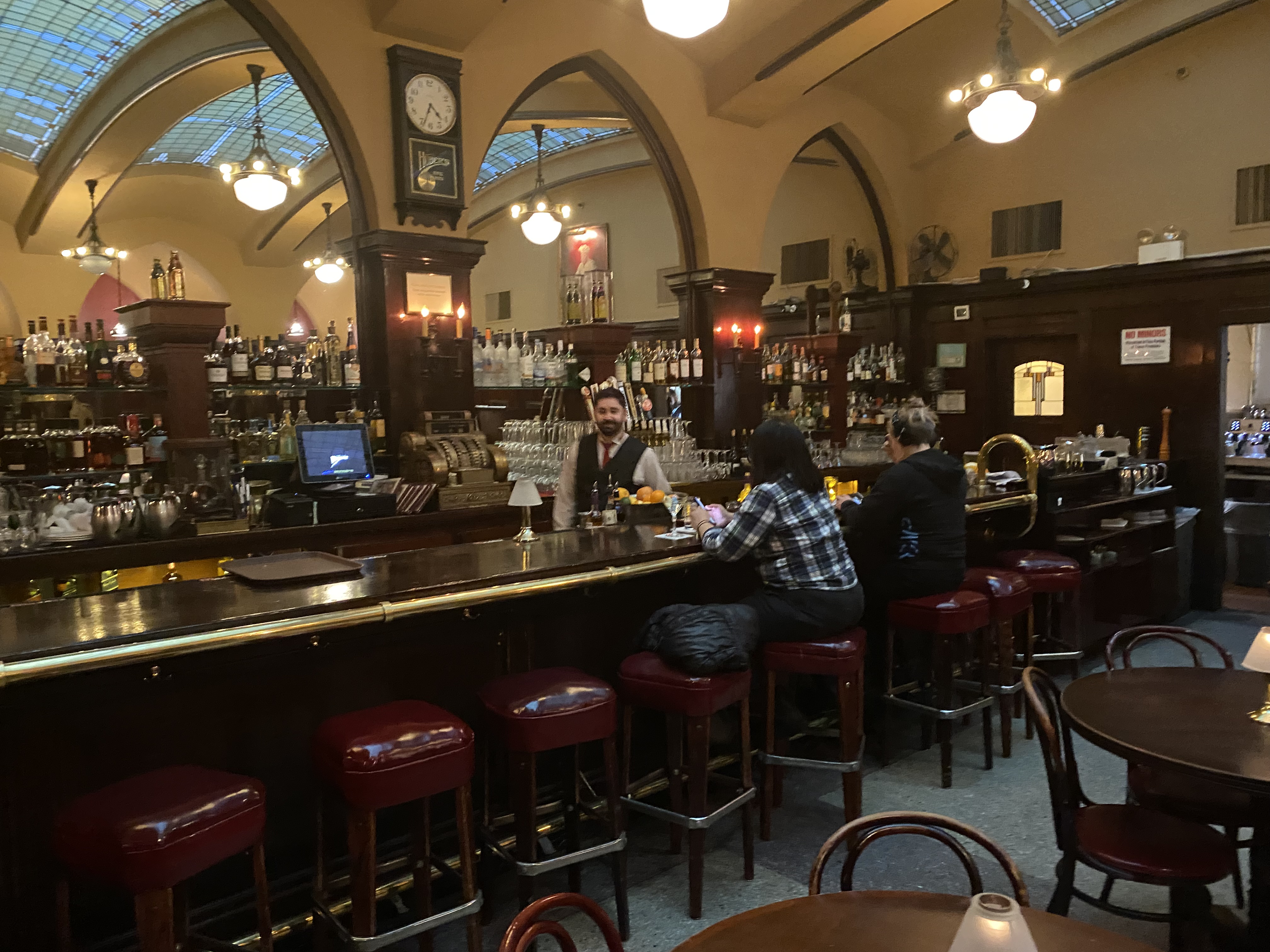
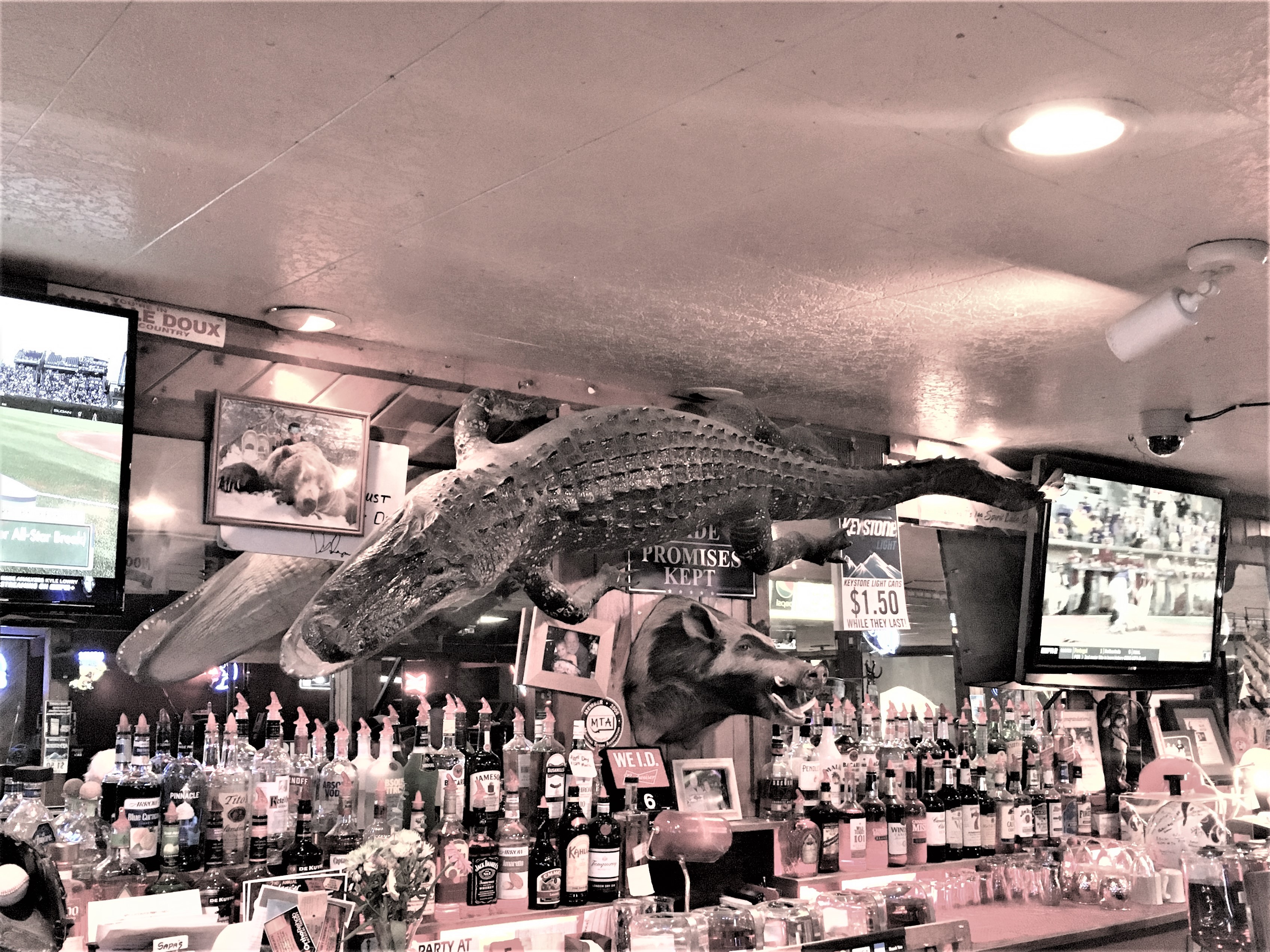
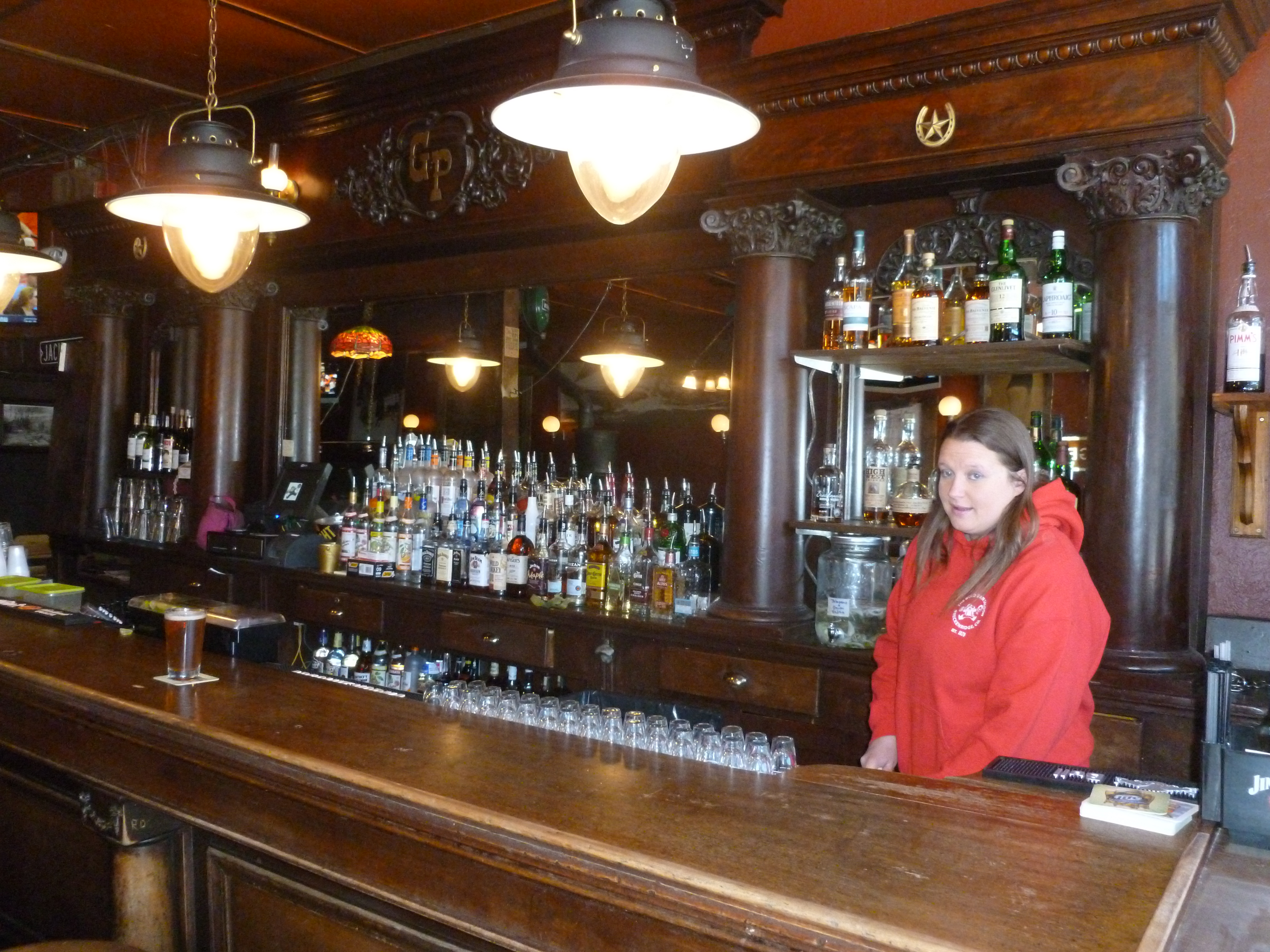
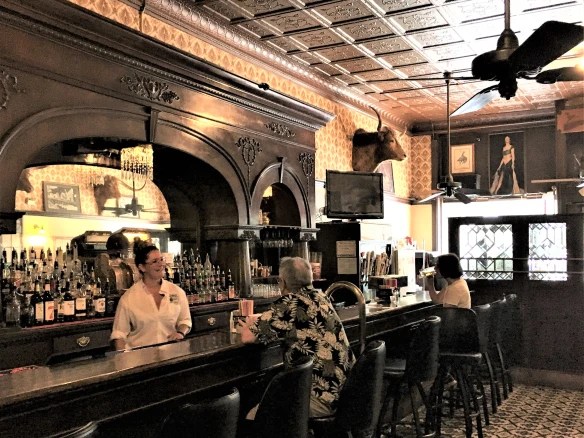
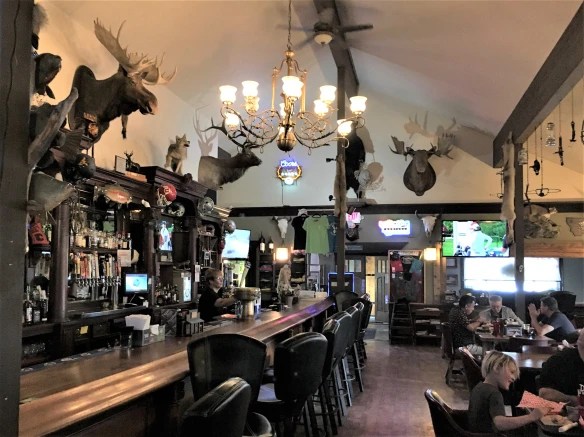
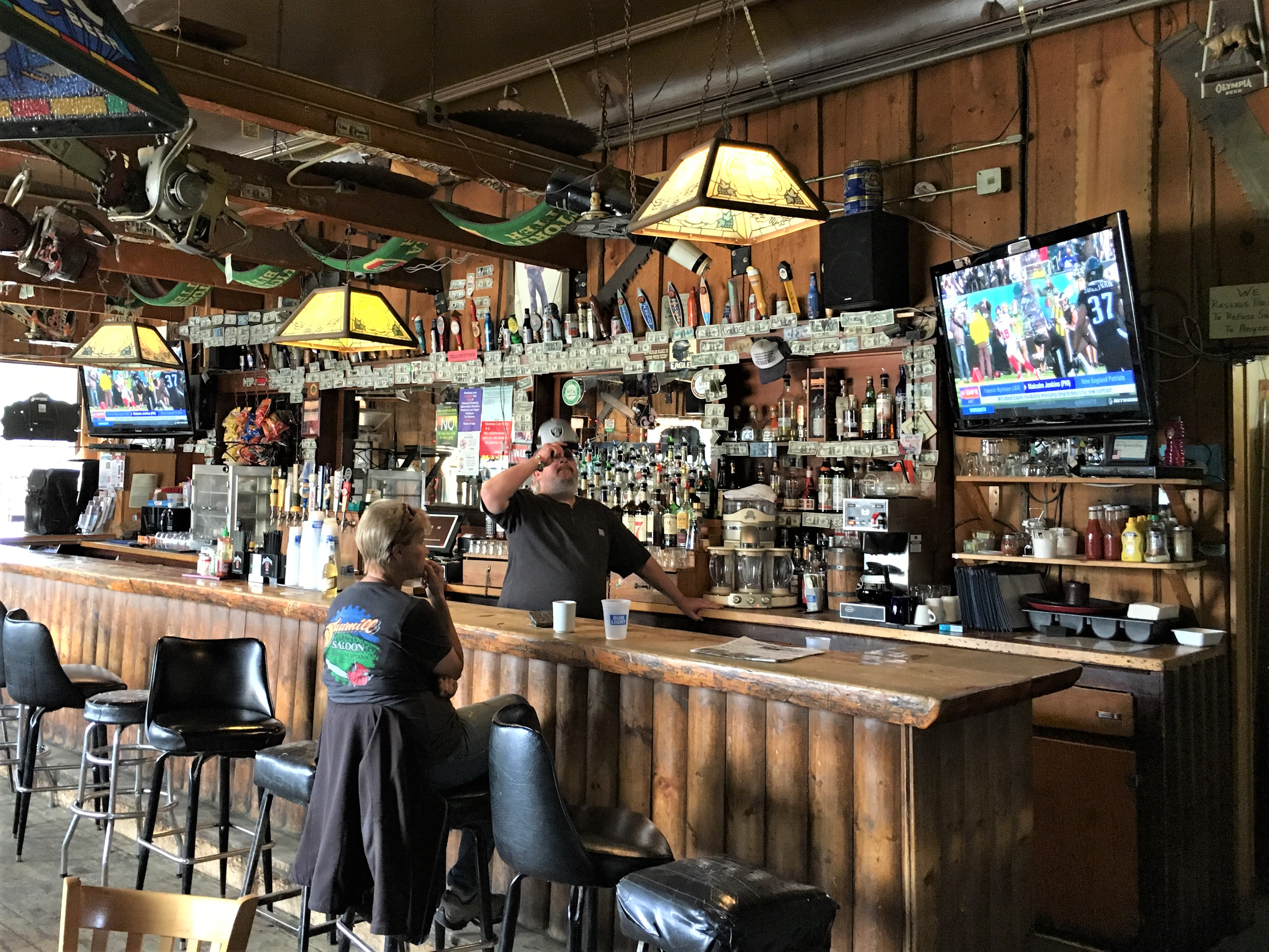
And the western US, most notably Montana and Colorado bars, where taxidermy and weapons often complement the historic ambiance.
Clockwise from left to right: Blue Moon Saloon – Columbus, Montana; Gold Pan Saloon – Breckenridge, Co.; Montana Bar – Miles City, Montana; Oxford Saloon – Missoula, Montana; Saw Mill Saloon – Darby, Montana; Trapper’s Saloon – Eureka, Montana.
(I have to admit that I’ve only seen one alligator hanging over a bar – at the Blue Moon Saloon in what is purported to be Montana’s longest bar. It’s not as scary, however, as the polar bear in an adjacent glass enclosed case.)
The Dining Room at Gino’s
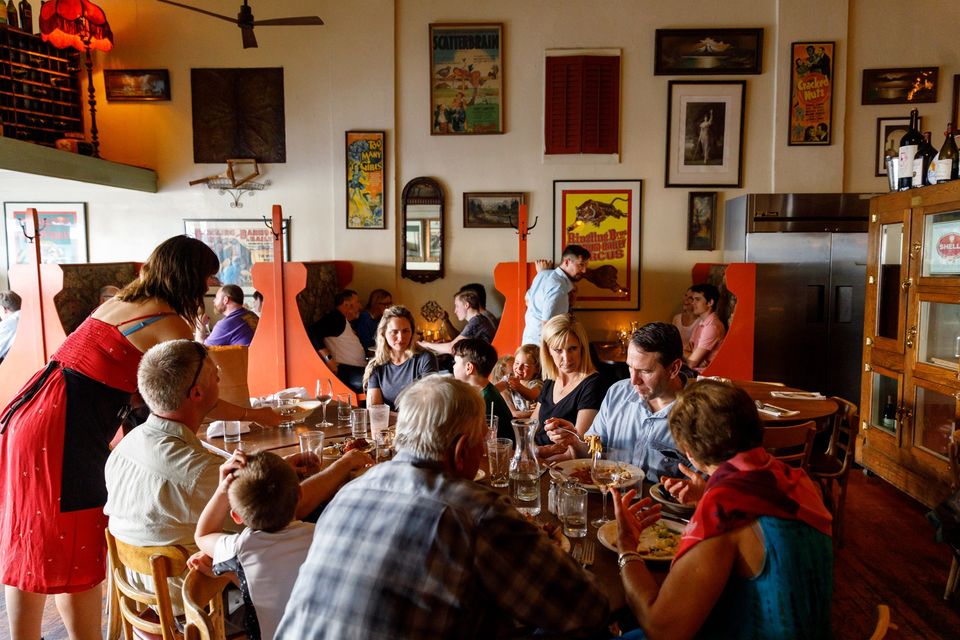
Gino’s dining room also has character. It’s reported to have once been a silent movie theater. There are interesting and colorful murals, antique furniture and scads of knick-knacks and mementoes from years past.
We had great sandwiches at our lunch and the dinner menu beckons for a return visit – it has variety and very reasonable prices. Read the following account from a 2018 Portland Eater article with Gino’s mom, Debbi recounting their favorite meal (and as remarkable as it seems these days, it’s still available for only $23 – see “Grandma Jean’s” on the menu).
“When Marc and I first opened our Italian restaurant in 1996, we lived upstairs, and every Christmas Eve we would have all the Accuardis in for a potluck—that was about 120 people.
And this was the dish: red sauce with pork ribs, stewed beef, and pepperoni (served over penne at Gino’s). The thing was, everyone—every aunt, uncle, and cousin—had their own version, and there would be huge arguments about the right way to make it. It’s all about when the herbs go in, basically.
This is a dish that goes generation to generation.” (#4)

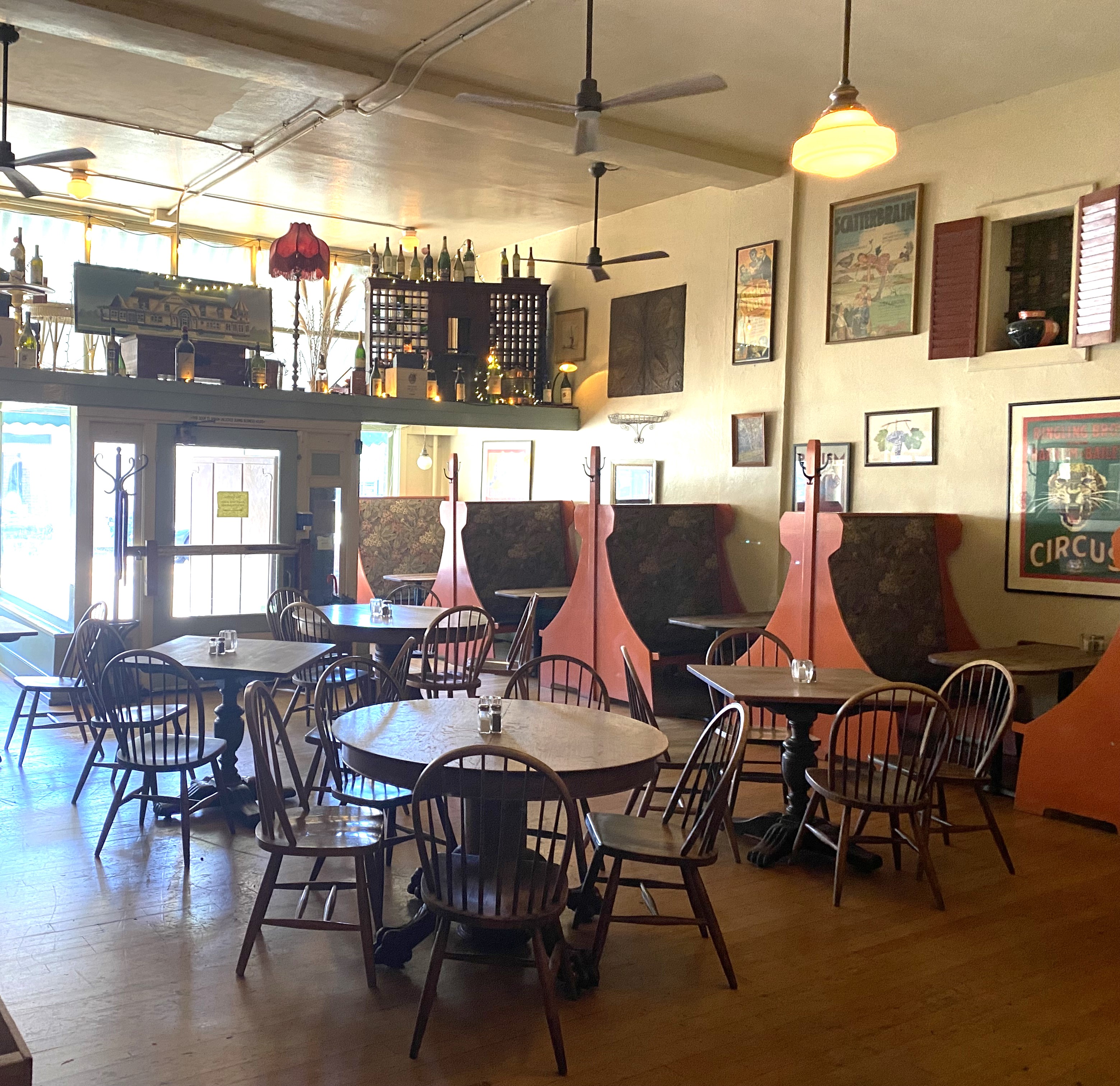
I asked Gino how business was during the pandemic and he stated:
“If I would have known at the beginning, what I know now, I might have thought twice, but we were both lucky and agile as we adjusted some things and tried new ideas that worked. We cooperated with the City and closing part of the street was really helpful.
We have a great clientele from all over the city, but especially our neighborhood. I live six blocks away and my daughter goes to school in the neighborhood. We focus on being a neighborhood establishment and they rallied for us.”
The spacious patio adjacent to the bar affirms Gino’s comment above.


In Closing, I Can’t Forget my Beerchasing Companions and the Hatfield School
I’m happy that my two lunch companions – both Gino regulars – Walt, from the date they opened – suggested Gino’s. We had great sandwiches and a good bottle of wine for lunch.
This August 2023 Trip Advisor review shows why Janet and I will return there for dinner:
“Wonderful experience. This is a magnificent restaurant. Great atmosphere, lovely Italian food, attentive staff. Not too noisy. Seasonal Caprese on the menu just now, is superb. Good bar, excellent and extensive wine list. The wines by the glass are first class and reasonably priced. Beers varied to suit all tastes.”
But let me tell you about the Hatfield School and the Master’s of Public Administration program at Portland State University. It’s dear to my heart and was a great help to both Janet and me during our careers in both the public and private sectors.
In the mid-seventies, I was working for Clackamas County and enjoying my work in local government. Based on the reputation of the MPA program at PSU, I applied and was admitted:
“The Mark O. Hatfield School’s degree, certificate, and continuing education programs are shaped by three overarching values: the importance of public service, the pursuit of social justice, and the quest for effective innovation in service delivery.” (#5)
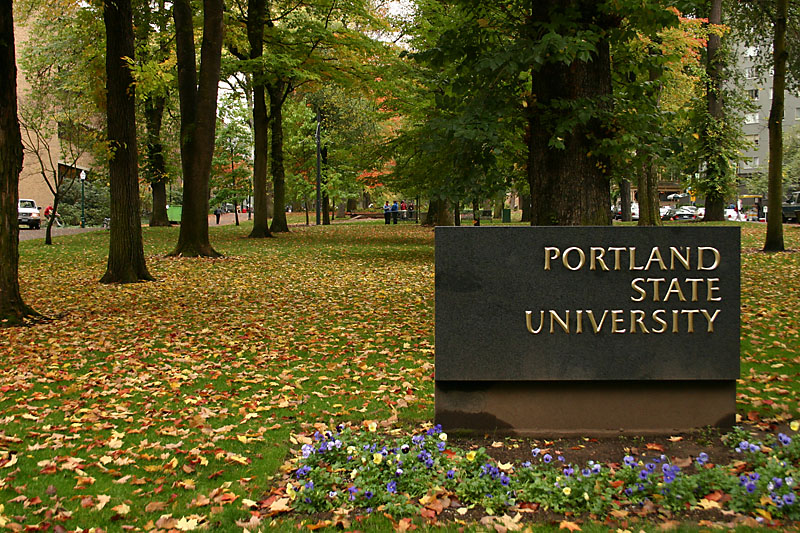
I had a demanding job (and a bachelor’s social life) and grad school began a long journey of taking one class per quarter for the next five years – usually on a weeknight from 6:00 until 9:00, if I remember correctly.
There were numerous papers occupying many weekends, but I was often able to integrate them into my job for the County Commissioners. The professors were first-rate and the classes practical and interesting.
Walt Ellis was my advisor and not only a great professor, but a wonderful and caring human being. His “Organizational Theory” class was of considerable use to me not only while I was in the public sector, but for the next twenty-five years in legal management.
Because of work demands (or at least that’s what I maintain now…) I took an incomplete with one major paper to complete to get credit. At that time, there were not personal computers and I typed some of the papers and hired a typist as well. There is a time limit on incompletes and that was tolling.
I had the paper completed, but only 50% typed on the last day to submit it. I knew where Walt lived so I drove to his house, knocked on his door with my paper in the late afternoon. Walt answered the door and I was prepared to beg for mercy – but I didn’t have to. He took the paper and said to his wonderful wife:
“Rosemary, don’t we have enough spaghetti for Don to join us for dinner?”
(It was a wonderful meal and I ended up with an A in the course.) You won’t believe it, but I still have two papers from Walt’s classes in 1978 – from the “Organizational Theory” and “Administrative Theory and Behavior” courses.
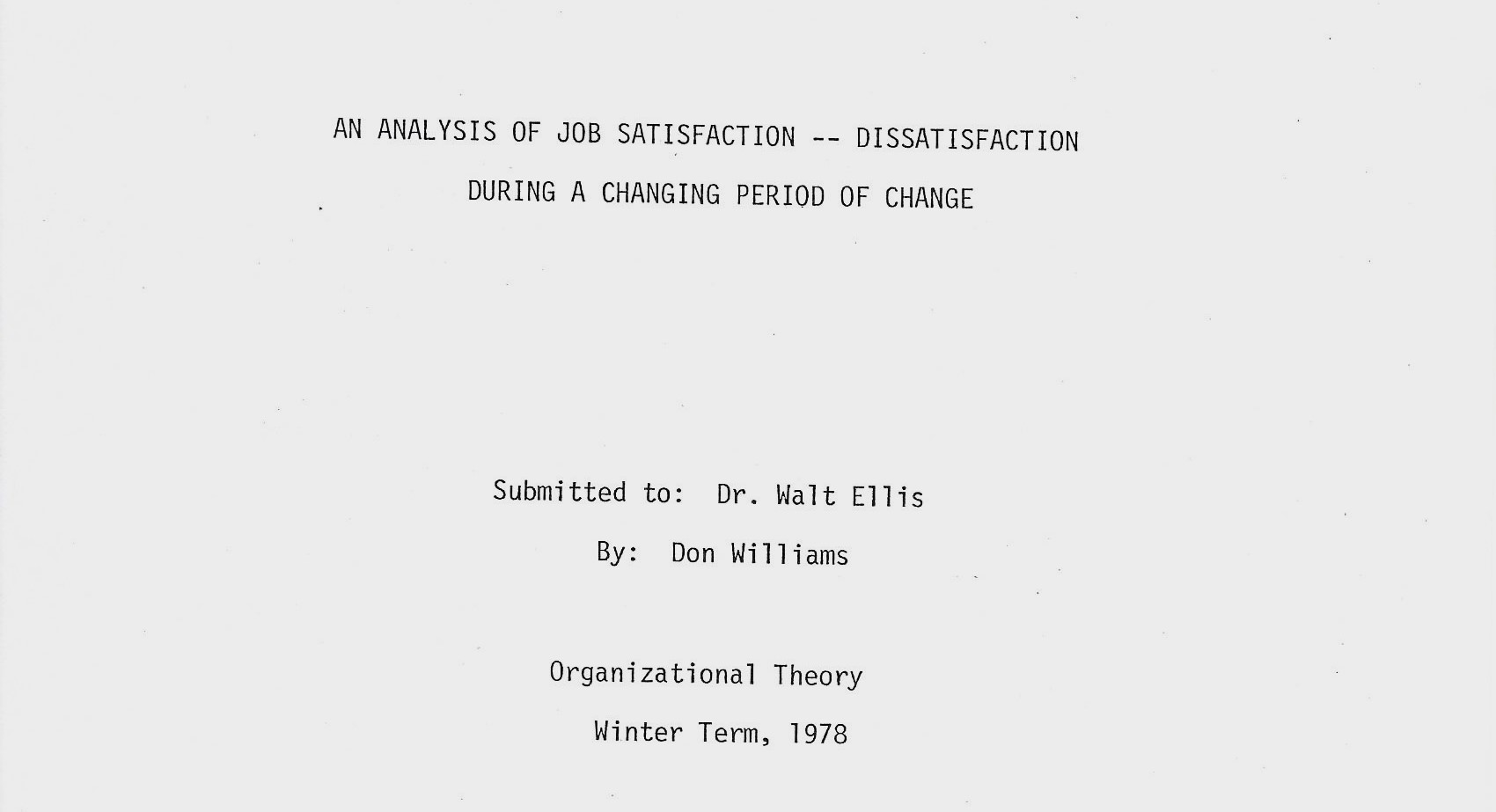
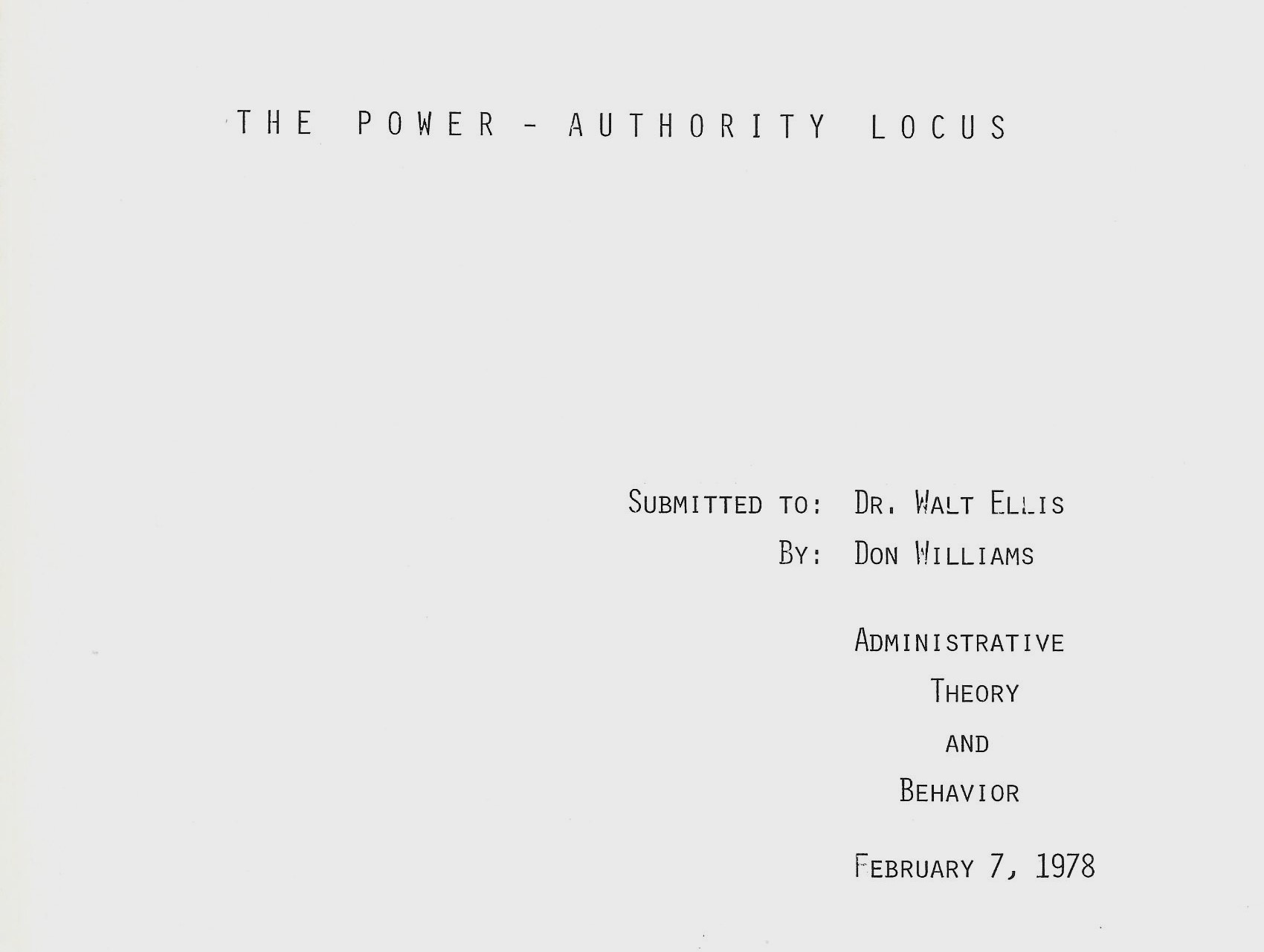
Walt also informed me that if I didn’t finish my two remaining courses in the next two terms, PSU was going to start deducting credits. This was right when I had started dating my future wife – Janet Dancer, who was working as the Assistant City Manager at Oregon City. (We met at a Planning Commission meeting.)
On our first date to a Portland Trailblazer game, I successfully lobbied her into enrolling in the MPA program. Janet had majored in Public Administration at the University of Oregon and, interestingly enough, had taken a course from Walt Ellis when he taught there.
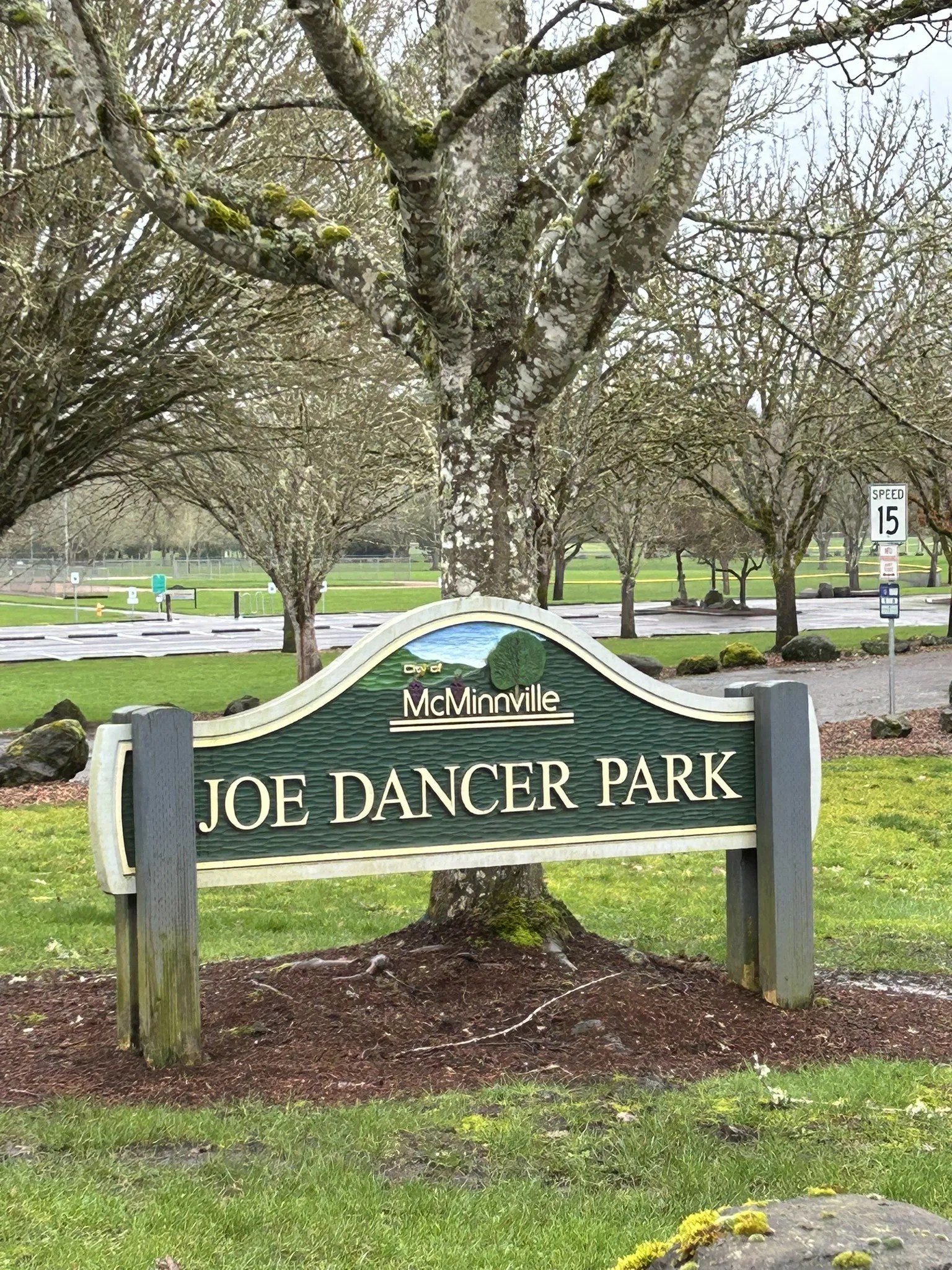
(Her dad, the late Joe Dancer, was the City Manager of McMinnville, Oregon for twenty-seven years and has a park named after him in the city.) (#6)

We married shortly afterwards and Janet and I took two terms of Data Analysis together – which came close to ruining our marriage and not just because she got a much higher grade on the first linear regression exam then I did. (#7)
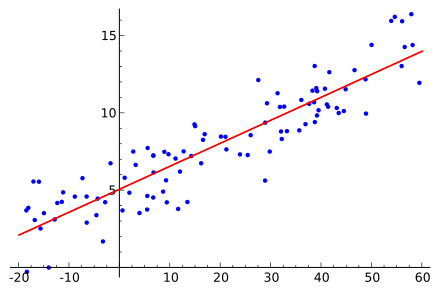
(She had a better grasp of linear regression.)
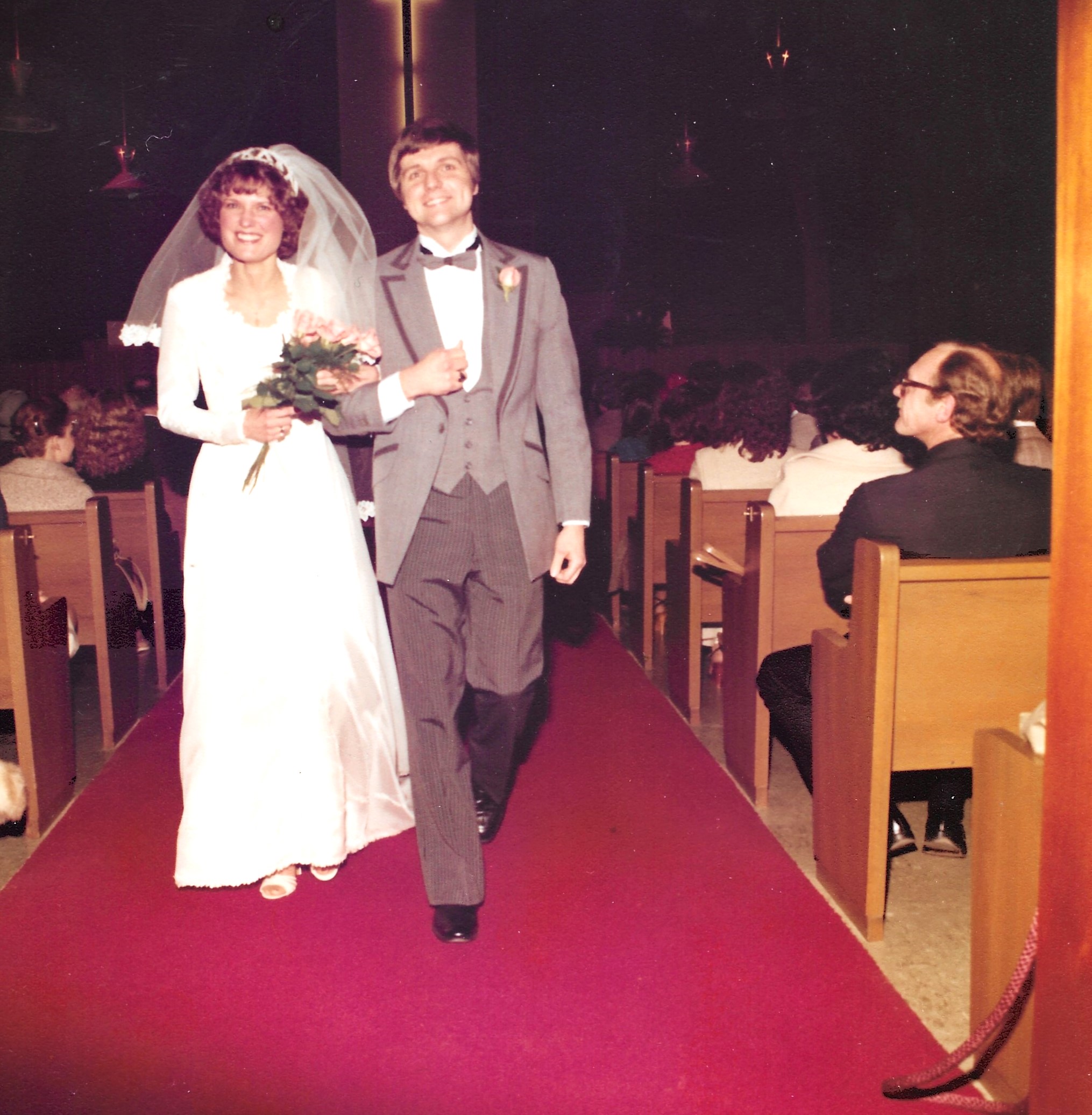
Does the guy in the pew look familiar?
We used to flip a coin to see who would drive to the now century-old Shattuck Hall on campus and stand in line to have the punch cards run through the mainframe and who would clean the bathrooms. (The winner got to clean the bathrooms.)
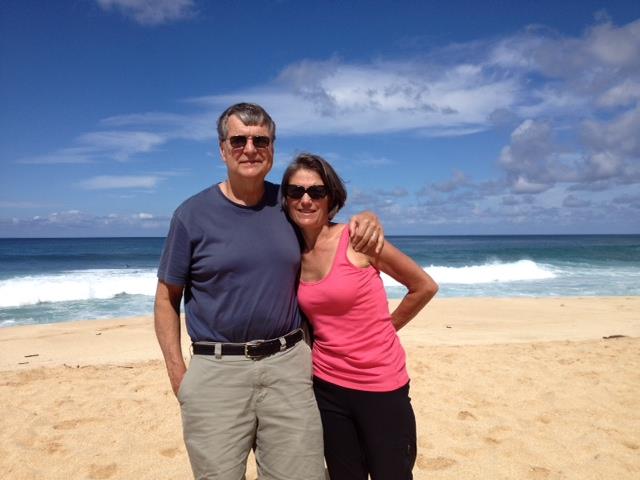
Our forty-four-year marriage survived Data Analysis and other challenges and we both got our MPA’s – although Janet in a much shorter period.

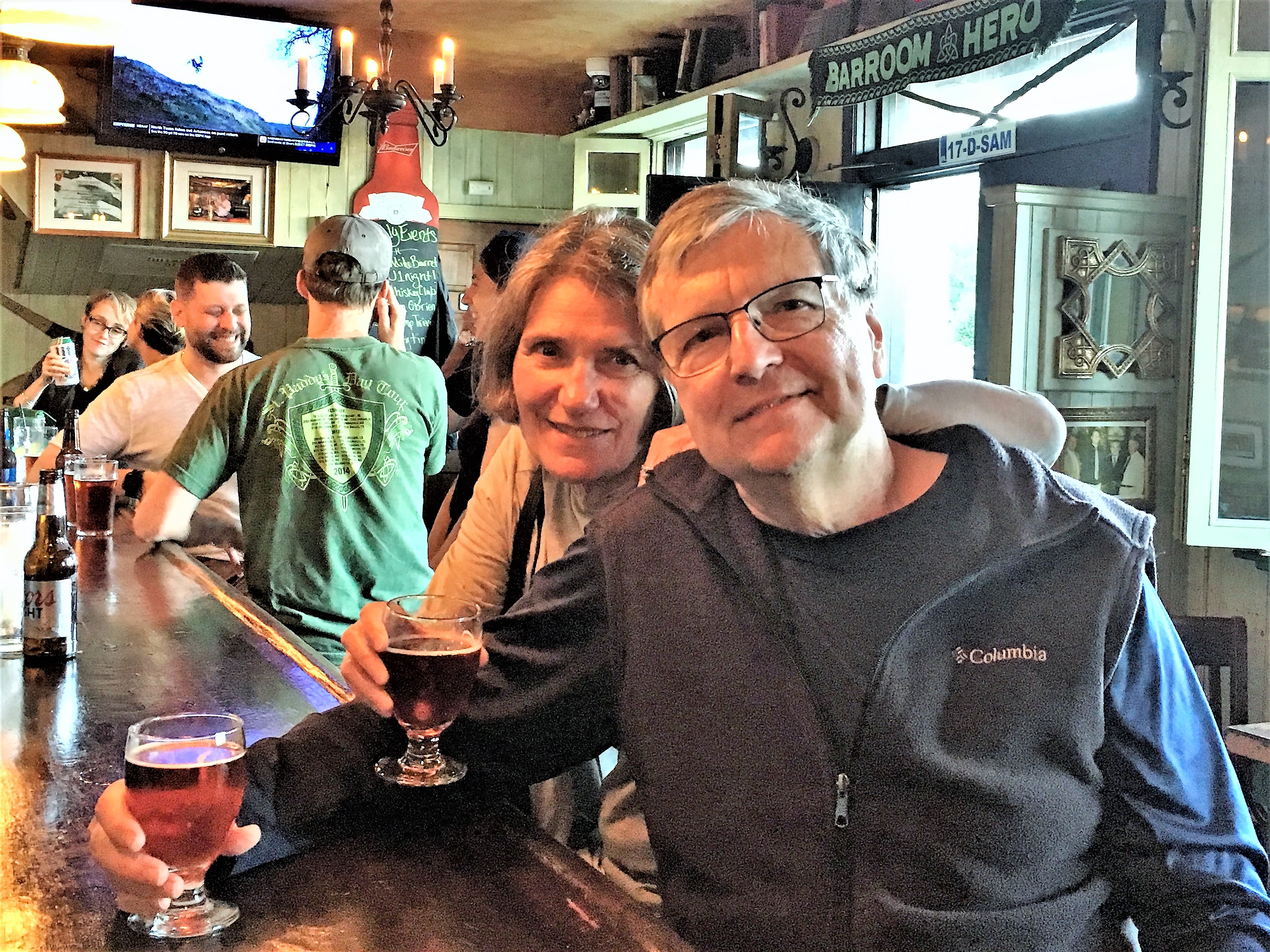
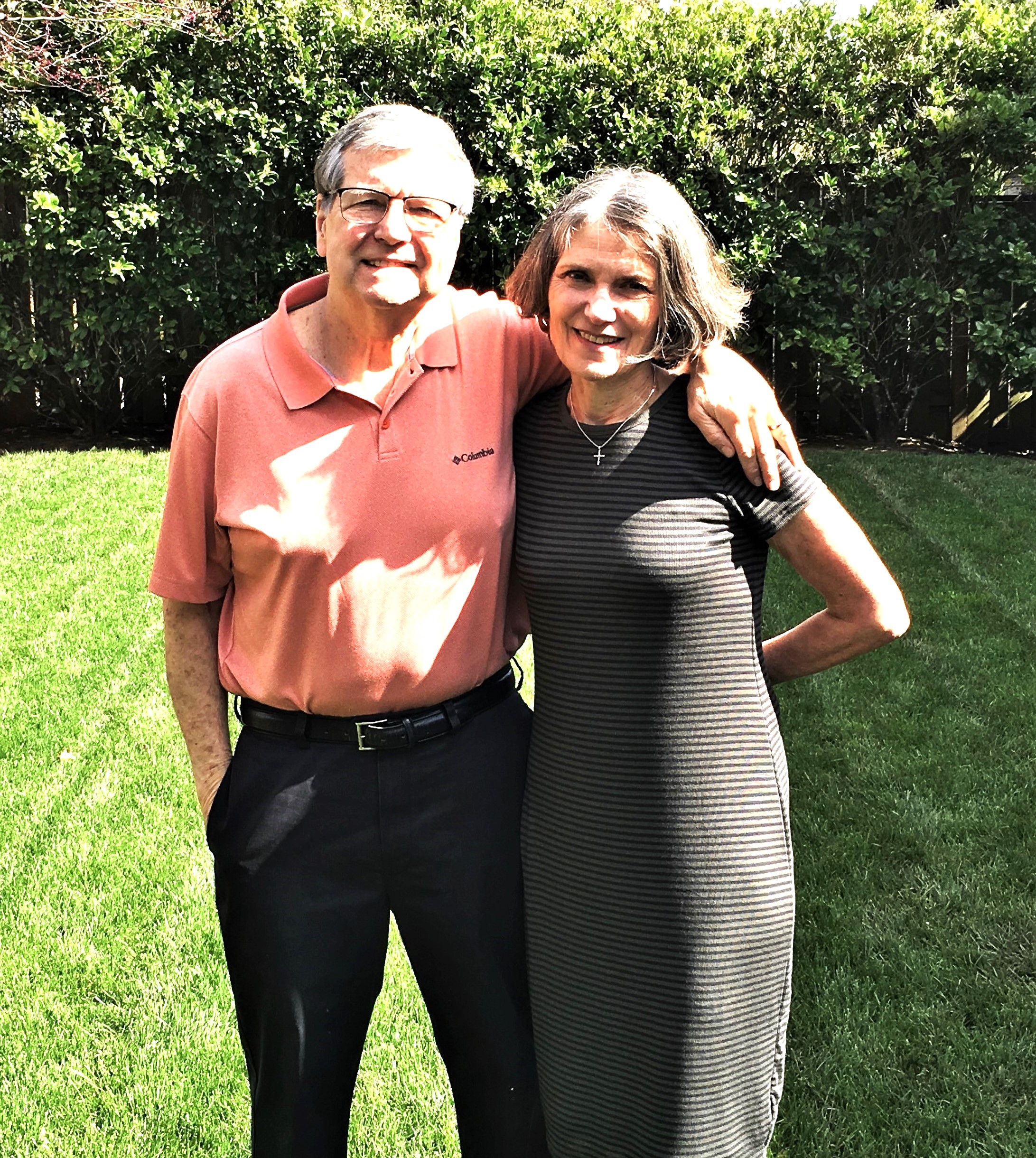

The Morgan – Ellis Family Endowment
I will conclude with a final accolade to these two outstanding academicians with an excerpt from the Spring Newsletter of the Hatfield School with a quote from Masami Nishishiba, Ph.D, Director.
“We were thrilled to announce the establishment of the ‘Morgan Ellis Family Endowment for Community-Centered Education, Scholarship, and Governance.’
This incredible initiative was kickstarted by two Emeriti Professors, Dr. Doug Morgan, Former Chair of the Department of Public Administration and the Founding Director of the Center for Public Service and Dr. Walt Ellis, Former Associate Dean of the College of Urban and Public Affairs. Their generous donation of $100,000 set the foundation for this endowment.” (#8)
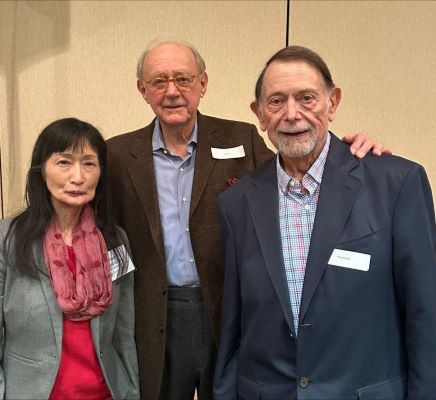
These two guys definitely walk their talk!
Cheers
External Photo Attribution
#1. Sanslartigue 2 – Sanslartigue 2: The silent camera continued.
#2. Wikimedia Commons (File:New Sellwood Bridge in September 2016.jpg – Wikimedia Commons) Licensed under the Creative Commons Attribution-Share Alike 4.0 International license. Author: September 2016
#3. Ginos Restaurant and Bar Website (Gino’s Restaurant & Bar (ginossellwood.com)).
#4. Gino’s Restaurant and Bar Facebook Page (https://www.facebook.com/ginossellwood/photos_by).
#5. Wikimedia Commons (File:Sign at entry to Portland State University (2004).jpg – Wikimedia Commons) Licensed under the Creative Commons Attribution-Share Alike 3.0 Unported license. Author: Kkmd at English Wikipedia – 20 October 2004.
#6. All Trails website (Photos of Joe Dancer Park – Oregon | AllTrails) Author: Paul Turchan.
#7. Public Domain – Wikimedia Commons (File:Linear Regression – it.svg – Wikimedia Commons). This work has been released into the public domain by its author, I, Berland. This applies worldwide. 28 October 2008.
#8. Portland State University website (What’s New in the Hatfield School of Government | Portland State University (pdx.edu).












.jpg)
